
Cabin Air Filter vs. Engine Air Filter: Two Very Different Jobs

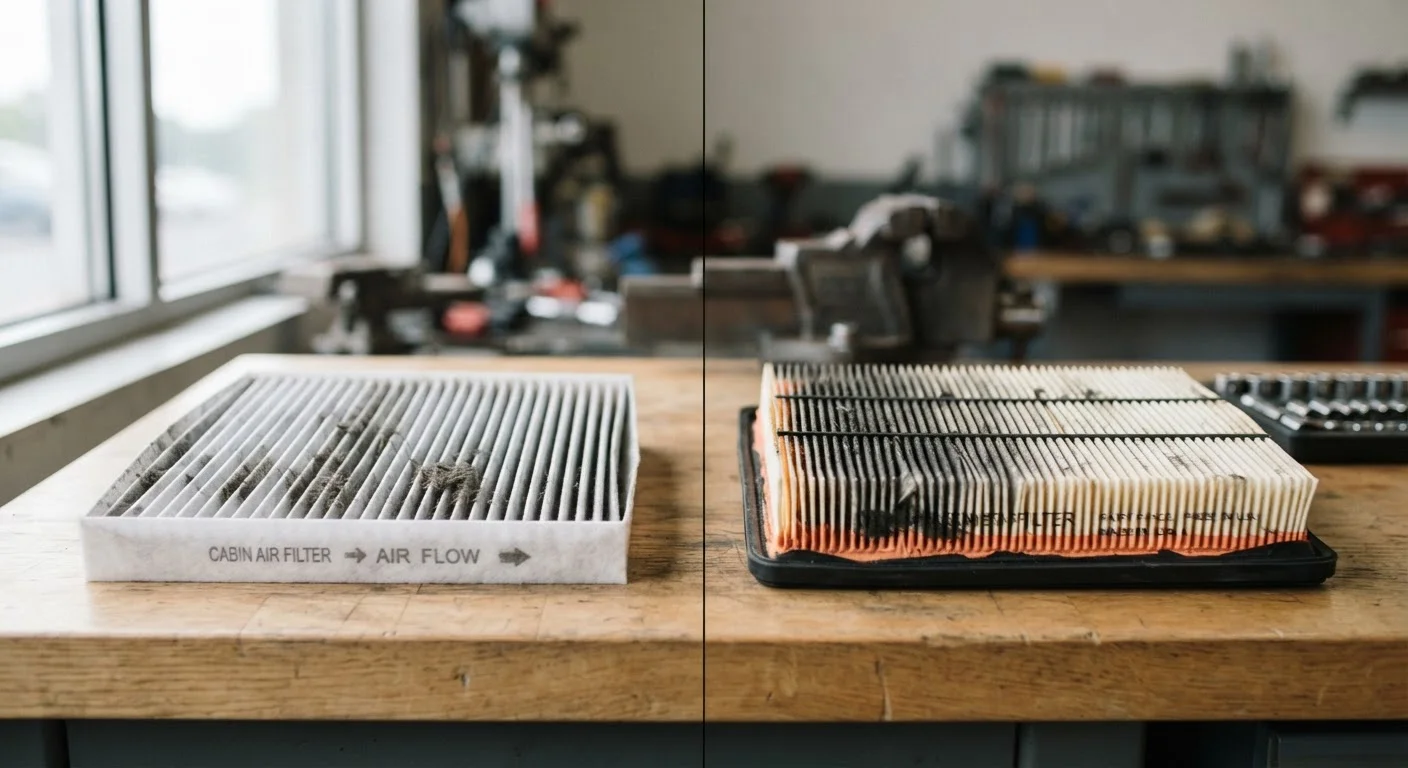
Photo: AnswersVista.com | Trustworthy Information Every Day editorial
Key Takeaways
- The cabin air filter cleans air entering the passenger compartment; the engine air filter cleans air entering the engine.
- These are two separate components - replacing one does not replace the other.
- Engine air filters typically need replacement every 15,000-30,000 miles; cabin filters every 15,000-25,000 miles.
- A clogged engine air filter can reduce fuel economy and cause long-term engine damage.
- A dirty cabin air filter degrades HVAC performance and air quality inside the car.
- Both filters are generally low-cost maintenance items, but neglecting them can lead to expensive consequences.
What Each Filter Actually Does
Despite sounding similar, the cabin air filter and the engine air filter serve entirely separate systems in your vehicle and should never be confused with one another.
The engine air filter sits in the engine bay, typically inside a plastic housing connected to the intake system. Its job is to trap dust, debris, pollen, and other contaminants before they enter the engine's combustion chambers. Engines require a precise mixture of clean air and fuel to run efficiently - dirty air compromises that balance, increasing wear on internal components over time.
The cabin air filter, on the other hand, is located inside the vehicle - usually behind the glove box, under the dashboard, or beneath the hood near the windshield base, depending on the make and model. It filters the air drawn through your heating, ventilation, and air conditioning (HVAC) system before it enters the passenger compartment. Think of it as the air purifier for the space where you actually sit.
In short: one protects your engine, the other protects you and your passengers. Both matter, and neither substitutes for the other.
| Criterion | Cabin Air Filter | Engine Air Filter |
|---|---|---|
| Primary function | Filters air entering the passenger cabin | Filters air entering the engine |
| Location | Inside the vehicle (dashboard or glove box area) | Engine bay, intake housing |
| What it protects | Occupant health and HVAC performance | Engine components and fuel efficiency |
| Typical replacement interval | Every 15,000-25,000 miles | Every 15,000-30,000 miles |
| Key failure symptom | Weak airflow, odors, more dust inside | Reduced power, worse fuel economy |
| DIY accessibility | Often tool-free on many models | Usually requires a screwdriver |
Signs Each Filter Needs Replacing
Because these filters serve different systems, the warning signs of a failing filter are also quite different.
Engine Air Filter Warning Signs
- Reduced fuel economy - a restricted airflow forces the engine to work harder and burn more fuel
- Sluggish acceleration - the engine may feel less responsive, particularly at lower speeds
- Check Engine light - in some vehicles, sensors detect an improper air-fuel ratio and trigger a warning
- Visible dirt or discoloration - a new filter is typically white or off-white; a heavily used one will be gray or brown
Cabin Air Filter Warning Signs
- Weak airflow from vents - even at high fan settings, air seems insufficient
- Musty or unpleasant odors when the HVAC system is running
- Increased dust on interior surfaces - the filter is no longer catching fine particles effectively
- Allergy symptoms worsening inside the car - pollen and particulates are passing through unchecked
25%
Potential drop in engine efficiency
According to the U.S. Department of Energy, a clogged engine air filter can reduce engine efficiency on older carbureted vehicles; modern fuel-injected engines may see reduced power and acceleration.
2x
Faster filter clogging in dusty conditions
Vehicles regularly driven on unpaved or dusty roads may need both air filters replaced up to twice as frequently as vehicles driven primarily on paved urban or suburban roads.
If you notice any of these symptoms, a visual inspection of the relevant filter is a practical first step. Many cabin filters are accessible without tools, though some engine air filter housings may require a basic screwdriver to open.
Replacement Intervals and Practical Advice
Manufacturer recommendations vary by vehicle and driving conditions, but the following general guidelines apply to most passenger cars and light trucks:
- Engine air filter: approximately every 15,000 to 30,000 miles, or as specified in your owner's manual
- Cabin air filter: approximately every 15,000 to 25,000 miles, though more frequent replacement may be warranted in dusty climates or high-pollen regions
Always consult your vehicle's owner's manual for the manufacturer's specific interval - driving in particularly dusty, rural, or heavily trafficked urban environments can accelerate how quickly both filters become clogged.
Both filters are among the more affordable routine maintenance items, and replacement is often straightforward enough that many drivers handle it themselves after reviewing their owner's manual. That said, if you're unsure about locating or accessing either filter on your specific vehicle, a qualified mechanic can inspect and replace them during a routine service visit.
One practical note: when you bring your car in for an oil change or inspection, ask your technician to check both filters. It's an easy add-on that ensures nothing is overlooked.
This article is for general informational and educational purposes only. Always consult your vehicle's owner's manual and, where appropriate, a qualified mechanic for guidance specific to your vehicle.
The content provided on our blog site traverses numerous categories, offering readers valuable and practical information. Readers can use the editorial team’s research and data to gain more insights into their topics of interest. However, they are requested not to treat the articles as conclusive. The website team cannot be held responsible for differences in data or inaccuracies found across other platforms. Please also note that the site might also miss out on various schemes and offers available that the readers may find more beneficial than the ones we cover.