
A Homeowner's Reference Guide to Common Plumbing Fittings

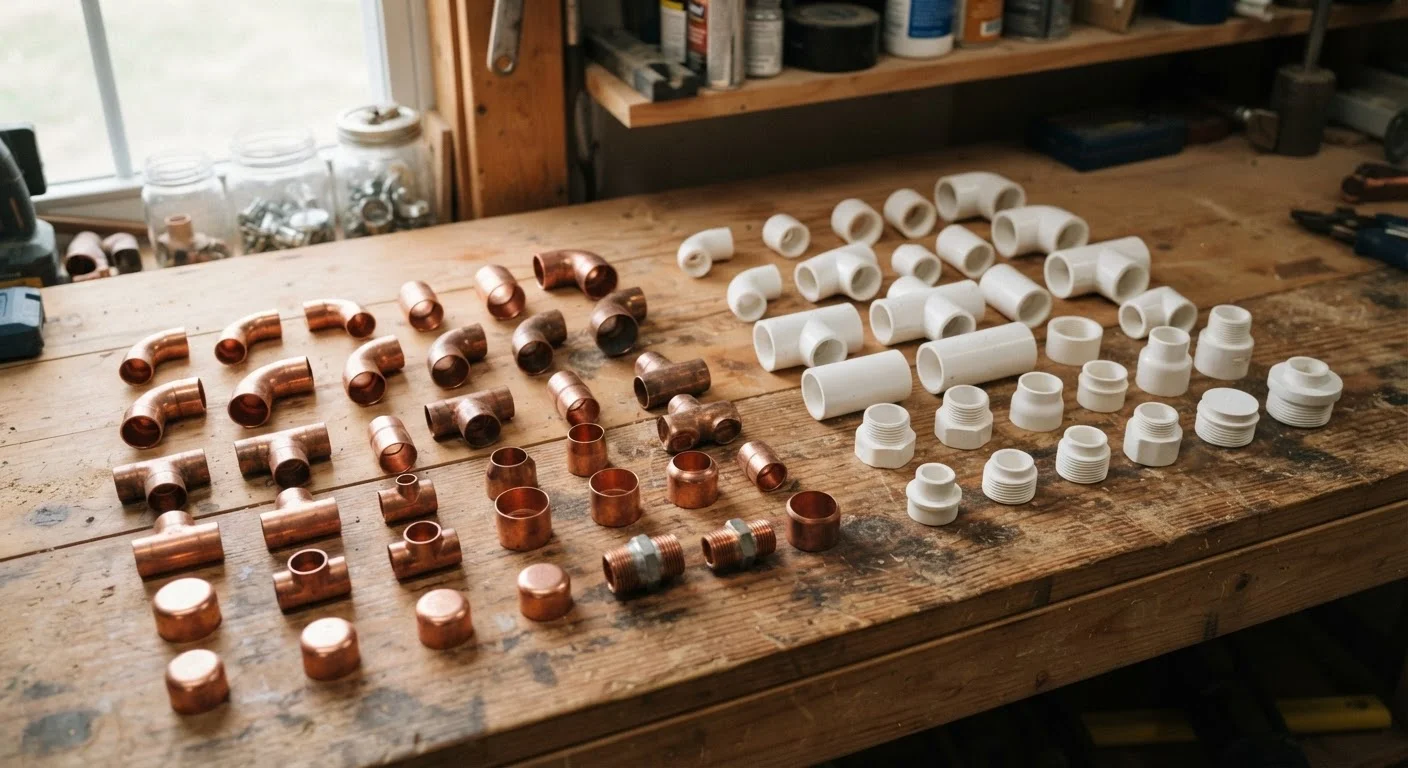
Photo: AnswersVista.com | Trustworthy Information Every Day editorial
Why Knowing Your Fittings Matters
Whether you're describing a leak to a plumber over the phone or picking up a part at the hardware store, using the correct terminology saves time and prevents costly mistakes. Plumbing fittings are the connectors that join pipes, change their direction, split flow, or change pipe diameter. Residential systems typically use fittings made from copper, CPVC, PVC, PEX, or galvanized steel - and each material has fittings designed specifically for it. This guide covers the most common fitting types you'll encounter in a standard home.
| Most common residential pipe materials | Copper, PVC, CPVC, PEX, galvanized steel |
| Standard thread type for U.S. residential fittings | NPT (National Pipe Taper) |
| Common elbow angles | 45° and 90° |
| Fitting to use between dissimilar metals | Dielectric union or dielectric nipple |
| Fitting that allows disassembly without cutting | Union |
| Fitting used to seal an open pipe end | Cap (exterior) or plug (interior) |
Note: This article is for general educational purposes. Always consult a licensed plumber before undertaking any work that requires permits, involves opening walls, or affects supply lines and drain stacks. Check local building codes for requirements in your area.
The Core Fitting Types Explained
Couplings
A coupling connects two pipes of the same diameter in a straight line. Standard couplings require cutting the pipe; slip couplings (also called repair couplings) can slide over existing pipe to bridge a damaged section without disassembling the full line - a useful distinction when making repairs.
Elbows
An elbow changes the direction of a pipe run. The two most common angles are 90-degree elbows (a sharp turn) and 45-degree elbows (a gentler angle that reduces flow resistance). A street elbow has one male and one female end, allowing it to connect directly to another fitting without a short pipe nipple between them.
Tees
A tee fitting is T-shaped and splits or combines flow at a branch point. The straight-through ports are called the run; the perpendicular port is the branch. A sanitary tee, used in drain-waste-vent (DWV) systems, has a curved interior that guides wastewater in the correct direction to prevent clogging and siphoning.
Reducers and Bushings
A reducer (or reducing coupling) connects pipes of two different diameters, stepping flow down from a larger to a smaller pipe or vice versa. A bushing does the same job but fits inside an existing fitting rather than between two pipe ends, making it a compact alternative when space is tight.
Unions
A union joins two pipes like a coupling but can be disassembled without cutting the pipe - it has a threaded nut that holds the two halves together. Unions are typically installed near water heaters, pumps, and valves to allow future maintenance without tearing out the entire line.
Caps and Plugs
A cap fits over the outside of a pipe end to seal it; a plug threads or fits inside a fitting to seal it. Both are used when capping off an unused branch or pressure-testing a system.
Coupling
A straight fitting that joins two pipes of the same diameter end-to-end. Slip couplings can slide over pipe to make repairs without cutting additional length.
Elbow
A fitting that changes the direction of a pipe run, available in 45-degree and 90-degree angles. Street elbows combine a male and female end for compact connections.
Tee
A T-shaped fitting that creates a branch off a main pipe run. Sanitary tees are curved internally for use in drain-waste-vent systems.
Reducer
A fitting that connects pipes of two different diameters, stepping flow up or down in size. Bushings perform the same function inside an existing fitting.
Union
A three-part fitting that joins two pipes and can be unscrewed and separated without cutting. Commonly installed near equipment that requires periodic service.
NPT (National Pipe Taper)
The standard tapered thread form used on most U.S. residential pipe fittings. The taper causes threads to wedge together and form a pressure-tight seal.
Galvanic Corrosion
An electrochemical reaction that occurs when two dissimilar metals are in contact in the presence of an electrolyte such as water, causing one or both metals to degrade.
Dielectric Union
A specialized union that uses a plastic sleeve and washer to electrically isolate two dissimilar metal pipes, preventing galvanic corrosion at the joint.
Solvent Welding
A method of joining PVC or CPVC pipe using chemical cement that softens and fuses the plastic surfaces together, creating a permanent bond.
DWV (Drain-Waste-Vent)
The portion of a home's plumbing that removes wastewater and sewage and vents sewer gases safely outside. DWV fittings are designed for gravity flow, not pressure.
Material and Thread Basics
Fittings must match both the pipe material and the thread type. The two most common thread standards in U.S. residential plumbing are NPT (National Pipe Taper), which creates a pressure-tight seal as threads tighten, and NPS (National Pipe Straight), which requires a gasket or O-ring to seal. Always confirm thread type before purchasing threaded fittings.
Mixing metals - such as connecting copper pipe directly to galvanized steel - can cause galvanic corrosion, a chemical reaction that degrades both materials over time. A dielectric union or dielectric nipple is designed specifically to separate dissimilar metals and prevent this reaction.
For plastic systems, solvent welding (using PVC or CPVC cement) creates a chemical bond rather than a mechanical one. PEX pipe uses crimp, clamp, or expansion fittings that require dedicated tools. Understanding these distinctions helps you communicate clearly with a plumber and recognize when a repair is within DIY scope versus when it warrants professional help - much like learning the terminology in any technical field. (If you find reference guides like this one useful, our Car Care A-Z glossary applies the same plain-English approach to vehicle maintenance terms.)
The content provided on our blog site traverses numerous categories, offering readers valuable and practical information. Readers can use the editorial team’s research and data to gain more insights into their topics of interest. However, they are requested not to treat the articles as conclusive. The website team cannot be held responsible for differences in data or inaccuracies found across other platforms. Please also note that the site might also miss out on various schemes and offers available that the readers may find more beneficial than the ones we cover.