
Engineered Hardwood vs. Solid Hardwood Flooring

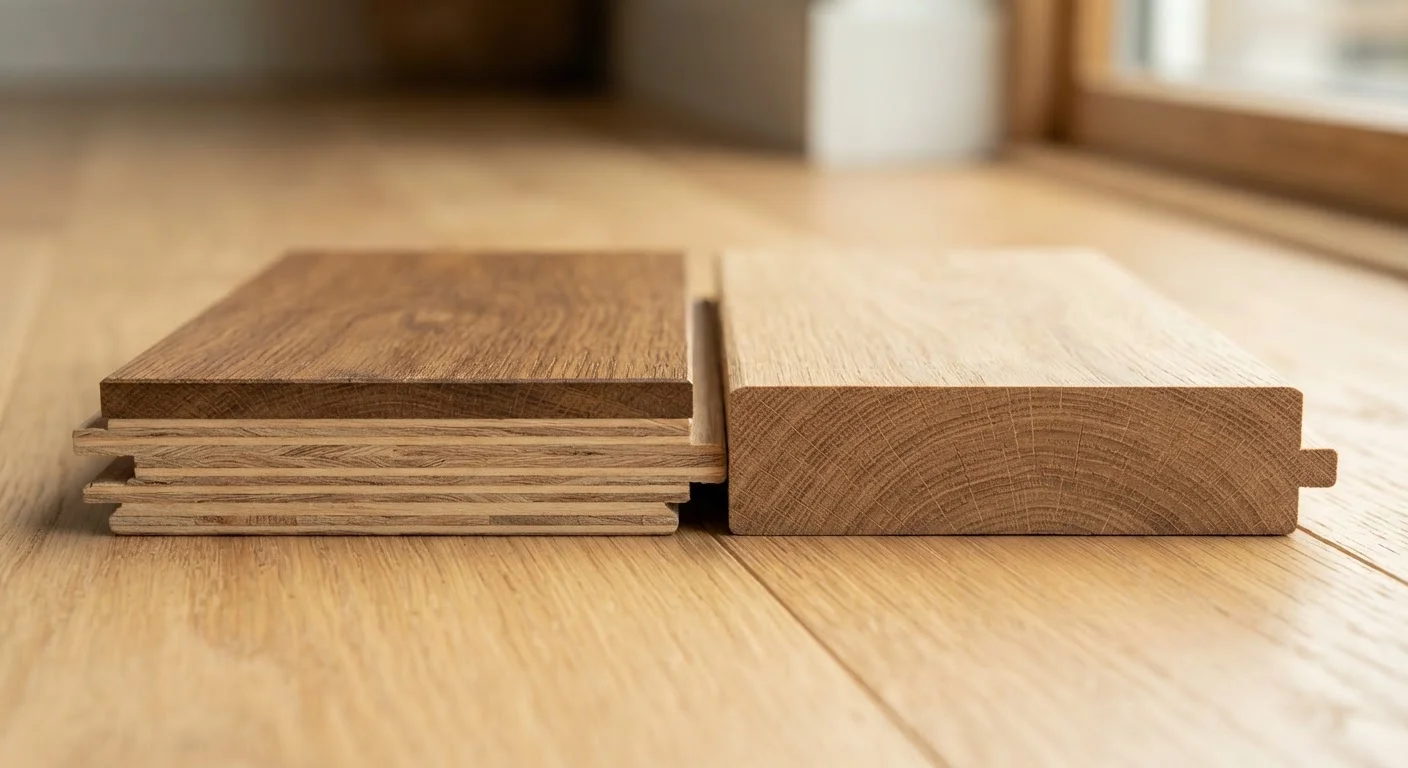
Photo: AnswersVista.com | Trustworthy Information Every Day editorial
Key Takeaways
- Engineered hardwood handles moisture and temperature swings better than solid hardwood due to its layered construction.
- Solid hardwood can be sanded and refinished more times, extending its lifespan in stable environments.
- Engineered hardwood is generally easier to install and works over concrete subfloors and radiant heat.
- Both options offer a real wood surface layer, making them visually comparable once installed.
- Your subfloor type, room location, and climate should drive the choice more than aesthetics alone.
How Each Floor Is Built
Understanding what's underneath the surface is the most important step in choosing between these two flooring types.
Solid hardwood is exactly what it sounds like: a single plank of wood milled from one piece of lumber, typically 3/4 inch thick. Species like oak, maple, hickory, and walnut are common choices. Because the plank is uniform wood throughout, it expands and contracts noticeably in response to changes in humidity and temperature - a characteristic that limits where it can be installed.
Engineered hardwood is constructed from multiple layers bonded together under heat and pressure. The top layer - called the wear layer or veneer - is real hardwood, typically ranging from 1/16 inch to 1/8 inch thick depending on the product. Beneath it are cross-directional layers of plywood or high-density fiberboard. This layered structure counteracts the natural tendency of wood to move, resulting in a floor that stays more dimensionally stable across a wider range of conditions. As noted in our guide on what makes products actually last, layered construction methods often outperform single-material construction in real-world stress conditions.
| Criterion | Engineered Hardwood | Solid Hardwood |
|---|---|---|
| Construction | Real wood veneer over plywood core | Single solid wood plank |
| Moisture resistance | Better; more dimensionally stable | Lower; prone to warping in humidity |
| Installation locations | Above, on, or below grade | Above grade only (typically) |
| Subfloor compatibility | Concrete or wood subfloor | Wood subfloor required |
| Radiant heat compatibility | Generally compatible | Limited; manufacturer-dependent |
| Refinishing potential | 1-3 times (wear layer dependent) | 4-8 times over lifespan |
| Typical lifespan | 25-40 years | 50-100+ years (stable conditions) |
| DIY installation | Possible with click-lock systems | Usually requires professional nail-down |
Moisture, Heat, and Where Each Floor Can Go
Room location is often the deciding factor between these two options. Solid hardwood is generally recommended only for above-grade installations - main floors and upper levels - in climate-controlled interiors. It should not be installed in basements, over concrete slabs without a wood subfloor, or in spaces with high humidity such as laundry rooms.
Engineered hardwood opens up more installation possibilities. It can be glued, floated, or stapled depending on the product and subfloor type, and many engineered options are rated for below-grade use. It also performs better over radiant heat systems, which cycle moisture and temperature in ways that can cause solid planks to gap or buckle.
3/4"
Typical solid hardwood plank thickness
This standard thickness allows multiple sanding cycles and is a key factor in solid hardwood's long refinishing lifespan.
35-55%
Ideal indoor relative humidity for hardwood floors
Wood flooring associations generally recommend maintaining this humidity range year-round to minimize expansion, contraction, and gapping in both floor types.
1/16"-1/8"
Engineered hardwood wear layer range
Thicker wear layers allow more refinishing passes; this spec should be confirmed before purchase to assess long-term durability.
That said, engineered hardwood is not waterproof. Standing water still damages the veneer and core layers. In truly wet areas like bathrooms, tile or luxury vinyl plank may be more appropriate than either hardwood option.
Refinishing, Lifespan, and Long-Term Maintenance
One of solid hardwood's strongest advantages is its refinishing potential. Because the plank is solid wood all the way through, it can typically be sanded and refinished four to eight times over its lifespan - enough to outlast generations of homeowners. A well-maintained solid hardwood floor in a stable environment can last 80 to 100 years or more.
Engineered hardwood's refinishing ability depends almost entirely on the thickness of the wear layer. Thin veneer products (around 1/16 inch) may only tolerate one light sanding, while thicker wear layers (3 mm or more) can handle two or three refinishing cycles. Always verify wear layer thickness before purchase - this is one of the specs worth scrutinizing carefully, as discussed in our piece on manufacturer specs vs. real-world performance.
Both flooring types benefit from consistent indoor humidity control - typically 35% to 55% relative humidity - regular sweeping, and prompt cleanup of spills. Neither should be damp-mopped aggressively.
Installation and Cost Considerations
Solid hardwood installation almost always requires a professional nail-down method over a wood subfloor, which adds labor cost and limits DIY options. Engineered hardwood, depending on the product, can be floated as a click-lock system that experienced DIYers can manage - though professional installation is still advisable for larger or complex spaces.
Material costs for both types vary considerably based on species, grade, and plank width. In general, engineered hardwood and solid hardwood overlap significantly in price range, so cost alone rarely settles the decision. Factor in your subfloor preparation needs, installation method, and long-term refinishing plans when comparing total project costs.
This article is for general home improvement information only. Costs, installation requirements, and product specifications vary by region and manufacturer. Consult a licensed flooring professional to evaluate your specific subfloor, room conditions, and local building requirements before making a final decision.
The content provided on our blog site traverses numerous categories, offering readers valuable and practical information. Readers can use the editorial team’s research and data to gain more insights into their topics of interest. However, they are requested not to treat the articles as conclusive. The website team cannot be held responsible for differences in data or inaccuracies found across other platforms. Please also note that the site might also miss out on various schemes and offers available that the readers may find more beneficial than the ones we cover.