
Financial Planning Across Life Stages: Your 20s Through Your 60s

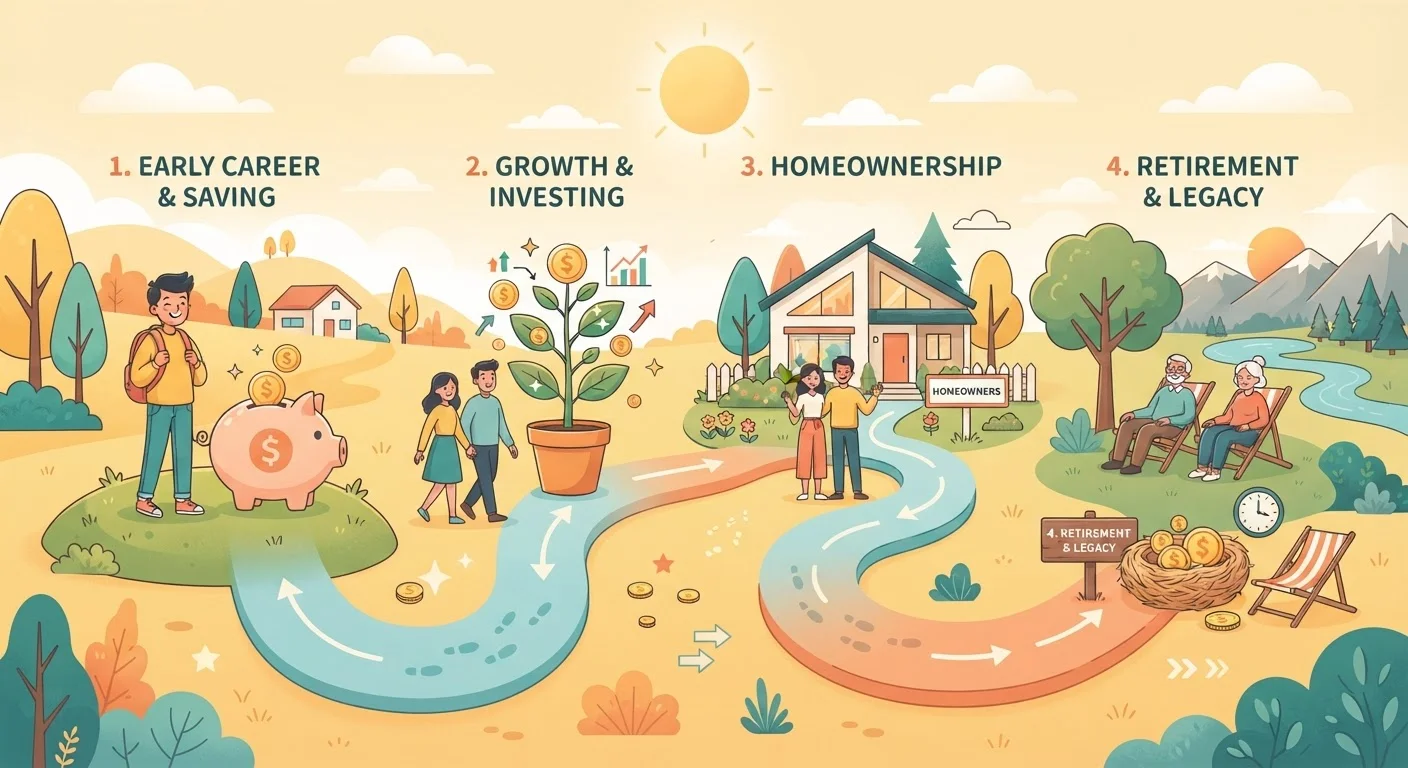
Photo: AnswersVista.com | Trustworthy Information Every Day editorial
Key Takeaways
- Starting retirement contributions early, even small ones, produces outsized long-term results due to compounding.
- Each decade carries distinct financial priorities - debt, protection, acceleration, and transition.
- Catch-up contributions in your 50s and 60s can meaningfully close retirement savings gaps.
- An annual financial review helps you stay aligned with changing goals across every life stage.
- No single plan fits every person; treat these frameworks as starting points, not prescriptions.
Why Life-Stage Planning Matters
Financial planning is not a one-size-fits-all exercise. The priorities that matter at 25 - like eliminating student debt and building an emergency fund - look very different from those at 55, when retirement is a decade away and catch-up contributions become available. Treating your financial plan as a living document, rather than a one-time exercise, is what separates people who feel in control from those who feel perpetually behind.
Understanding the difference between a financial goal and a financial plan is the first step. Goals give you direction; plans give you a mechanism. Both are essential, and both need to evolve as your income, family, and obligations change.
This guide maps the key considerations for each major life decade - not as a rigid prescription, but as a framework you can adapt to your own situation.
Your 20s: Build the Foundation
Your 20s are when financial habits form. The choices made now compound - for better or worse - over the next four decades. Three priorities dominate this stage.
Start an Emergency Fund
Before investing a dollar, aim to accumulate three to six months of essential living expenses in a liquid account. This buffer prevents a job loss or unexpected bill from forcing you into high-interest debt. See our foundational saving and debt guidance for practical strategies.
Contribute to Employer Retirement Plans
If your employer offers a 401(k) match, contribute at least enough to capture the full match - passing it up is leaving compensation on the table. Even modest contributions in your 20s benefit enormously from decades of compounding growth.
Tackle High-Interest Debt Aggressively
Credit card debt and high-rate personal loans erode wealth faster than most investments can recover it. Prioritize paying these off while maintaining minimum payments on lower-rate obligations like federal student loans.
Automate your savings contributions from day one - even $50 a month builds the habit and removes the temptation to spend first.
In your 40s, run a retirement projection using a free online calculator before making any large discretionary purchases or career changes.
Your 30s: Strengthen and Protect
The 30s often bring higher income alongside higher complexity: mortgages, children, career pivots, and growing responsibilities. The goal is to protect what you've built while accelerating progress.
Increase Retirement Contributions
With income typically rising, increase your retirement savings rate toward 15% of gross income - including any employer match. If you haven't started yet, begin now; the cost of delay grows steeper every year, as research on retirement shortfalls consistently demonstrates.
Review Insurance Coverage
Term life insurance and disability insurance become critical if others depend on your income. Many 30-somethings are underinsured in these areas, which creates significant financial risk for their families.
Build a Written Budget
A household budget isn't just for people in financial trouble - it's a tool for intentional spending at any income level. Simple budgeting strategies help you track where money goes and redirect it toward priorities.
Cashing Out a 401(k) Early Has Lasting Costs
Your 40s: Accelerate and Reassess
Your 40s are often peak earning years, which makes them the highest-leverage decade for savings. They're also a time when retirement shifts from abstract to real.
57%
Americans financially unprepared for retirement
According to the Federal Reserve's Report on the Economic Well-Being of U.S. Households, more than half of non-retired adults feel their retirement savings are not on track.
$7,000
2024 IRA annual contribution limit
The IRS set the 2024 IRA contribution limit at $7,000 for those under 50, with a $1,000 catch-up addition allowed for those 50 and older.
10x
Recommended retirement savings by age 67
A widely cited rule of thumb from retirement researchers suggests accumulating roughly ten times your final salary by the time you retire.
Run a Retirement Projection
Use a free retirement calculator to model whether your current savings trajectory reaches your target. If you're behind, the 40s offer the most time to close the gap before retirement approaches. Misconceptions about how much is "enough" can derail this stage - common retirement planning myths are worth examining directly.
Diversify Investments Thoughtfully
Asset allocation - the mix of stocks, bonds, and other assets in your portfolio - should generally shift toward somewhat less volatility as retirement nears, though the right mix depends on your specific timeline and risk tolerance. A licensed financial adviser can help you assess this. Past market performance does not guarantee future results.
Eliminate Mid-Range Debt
Work toward paying off auto loans and any remaining personal debt so that pre-retirement years can focus entirely on saving and investing.
Your 50s and 60s: Transition to Retirement
The decade before retirement is both the most critical and, for many people, the most anxiety-producing. Fortunately, the tax code provides meaningful help.
Use Catch-Up Contributions
Starting at age 50, the IRS allows additional "catch-up" contributions above standard limits. In 2024, workers 50 and older can contribute up to $30,500 to a 401(k) and $8,000 to an IRA. These provisions exist precisely because many people arrive at this stage with savings gaps to close.
Contribution Limits Change Annually
Develop a Social Security Strategy
Claiming Social Security earlier (as young as 62) reduces your monthly benefit permanently; delaying beyond full retirement age increases it up to age 70. Modeling these scenarios with the Social Security Administration's estimator can significantly affect lifetime income.
Plan for Healthcare Costs
Healthcare is one of the largest and least predictable retirement expenses. Understanding Medicare eligibility timelines and estimating out-of-pocket costs should be part of any pre-retirement plan.
Review Your Plan Every Year
This article provides general financial education and is not personalized financial, tax, or legal advice. Please consult a qualified professional for guidance specific to your situation.
Principles That Apply at Every Stage
Regardless of your decade, a few principles consistently support financial well-being.
- Automate contributions so saving happens before spending.
- Review beneficiary designations on retirement accounts and insurance policies after any major life event.
- Avoid lifestyle inflation - allowing spending to grow as fast as income eliminates the benefit of earning more.
- Maintain a written plan that connects your goals to specific, measurable actions. Our guide on building a financial plan from scratch is a useful starting point.
This Is General Information, Not Personal Advice
Financial planning across decades isn't about perfection at each stage - it's about consistent, informed choices that compound over time. Start where you are, adjust as life changes, and seek professional guidance for decisions that carry significant financial weight.
The content provided on our blog site traverses numerous categories, offering readers valuable and practical information. Readers can use the editorial team’s research and data to gain more insights into their topics of interest. However, they are requested not to treat the articles as conclusive. The website team cannot be held responsible for differences in data or inaccuracies found across other platforms. Please also note that the site might also miss out on various schemes and offers available that the readers may find more beneficial than the ones we cover.