
Reading a VIN: The 17-Character Code That Tells Your Car's Full Story

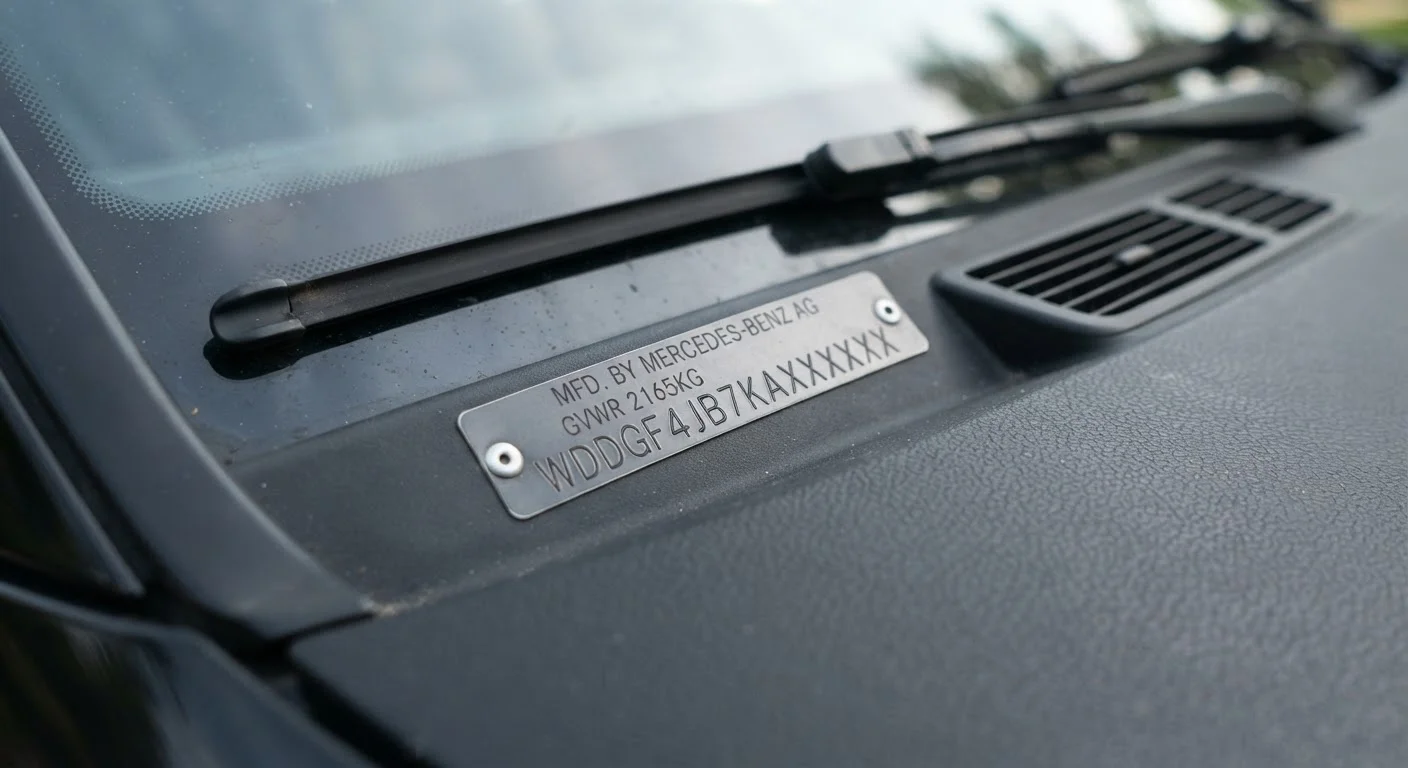
Photo: AnswersVista.com | Trustworthy Information Every Day editorial
What a VIN Is - and Why It Matters
A Vehicle Identification Number (VIN) is a unique 17-character code assigned to every motor vehicle manufactured for sale in the United States since 1981. Think of it as a fingerprint: no two vehicles share the same VIN. That string of letters and numbers encodes a surprising amount of information - from the country where your car was assembled to the specific plant that built it and the sequence in which it rolled off the line.
Understanding your VIN helps you verify a used car's history, confirm the right parts when ordering replacements, and cross-reference recall notices. It's also the identifier mechanics use when pulling your vehicle's service history - which connects directly to keeping up with your maintenance schedule.
| VIN length | 17 characters (NHTSA standard, effective 1981) |
| Characters excluded from VIN | I, O, Q, U, Z (Excluded to prevent confusion with 1, 0, and other numerals) |
| Position encoding model year | Character 10 (Standardized alphanumeric table per NHTSA) |
| Primary recall lookup tool | NHTSA VIN lookup (nhtsa.gov) (Free, official U.S. government resource) |
| U.S. country code prefix | 1, 4, or 5 (World Manufacturer Identifier standard) |
Breaking Down the 17 Characters
The National Highway Traffic Safety Administration (NHTSA) standardized the VIN format in 1981. Each position in the sequence has a defined meaning:
Characters 1-3: World Manufacturer Identifier (WMI)
The first character identifies the country of manufacture. For example, codes starting with 1, 4, or 5 indicate the U.S.; J indicates Japan; W indicates Germany. The second character narrows it to the manufacturer, and the third to the vehicle type or division. Together these three characters form the World Manufacturer Identifier.
Characters 4-8: Vehicle Descriptor Section (VDS)
This five-character block describes the vehicle itself. Manufacturers use these positions to encode body style, engine type, restraint systems, and series or trim level. The exact coding varies by manufacturer - there is no universal standard for these five characters - so decoding them fully requires consulting the specific automaker's scheme or a VIN decoder tool.
Character 9: Check Digit
Position 9 is a mathematical check digit calculated from the other characters using a formula set by NHTSA. Its sole purpose is to validate that the VIN is legitimate - a useful safeguard against counterfeit or tampered numbers.
Character 10: Model Year
This single character is one of the most useful to know. It encodes the model year using a standardized alphanumeric table: for example, A = 1980, B = 1981 … Y = 2000, 1 = 2001 … and the cycle repeats. The letter I, O, Q, U, and Z are excluded to avoid confusion with numbers.
Character 11: Plant of Assembly
This character identifies the specific manufacturing plant where the vehicle was assembled. Its meaning is defined by each manufacturer.
Characters 12-17: Vehicle Production Sequence Number
The final six digits are the sequential production number - essentially the order in which that vehicle came off the assembly line at that plant. This is what makes every VIN unique.
VIN
Vehicle Identification Number - a standardized 17-character alphanumeric code uniquely identifying every motor vehicle. Mandated in the U.S. for all vehicles manufactured since 1981.
World Manufacturer Identifier (WMI)
The first three characters of a VIN that identify the country of manufacture and the automaker. Assigned and maintained by SAE International.
Vehicle Descriptor Section (VDS)
Characters 4 through 8 of the VIN, used by manufacturers to encode vehicle attributes such as body style, engine type, and trim series.
Check Digit
The ninth character of a VIN, calculated mathematically from the remaining characters to verify the VIN's authenticity and detect fraudulent or altered numbers.
Model Year Code
The tenth character of a VIN, representing the vehicle's model year using a standardized alphanumeric table defined by NHTSA.
Production Sequence Number
Characters 12-17 of the VIN - a sequential number assigned at the assembly plant that makes each VIN globally unique.
Where to Find Your VIN and How to Use It
Your VIN appears in several locations on your vehicle and in your ownership documents:
- Dashboard plate: Visible through the lower-left corner of the windshield on the driver's side - the most commonly referenced location.
- Driver's door jamb: On a sticker on the door frame or B-pillar.
- Title, registration, and insurance card: All official documents include the VIN.
- Engine block and frame: Stamped directly on the vehicle for anti-theft verification.
Once you have the VIN, you can use it in several practical ways. The NHTSA's free online lookup tool lets you check for open safety recalls by VIN - a critical step before buying any used vehicle. Commercial vehicle history services use VINs to compile records of reported accidents, title transfers, and odometer readings. Parts retailers rely on VINs to confirm the correct components for your specific configuration, since two vehicles with the same model name may use different parts depending on trim or engine.
If a seller is reluctant to provide a VIN before purchase, treat that as a significant red flag. A legitimate VIN should also be consistent across the dashboard plate, door jamb, and paperwork - discrepancies can indicate tampering. This is the kind of detail a trained technician will verify during a pre-purchase inspection; see what your mechanic evaluates during a multi-point check for a fuller picture.
The content provided on our blog site traverses numerous categories, offering readers valuable and practical information. Readers can use the editorial team’s research and data to gain more insights into their topics of interest. However, they are requested not to treat the articles as conclusive. The website team cannot be held responsible for differences in data or inaccuracies found across other platforms. Please also note that the site might also miss out on various schemes and offers available that the readers may find more beneficial than the ones we cover.