
Transmission Types Decoded: Manual, Automatic, CVT, and Dual-Clutch

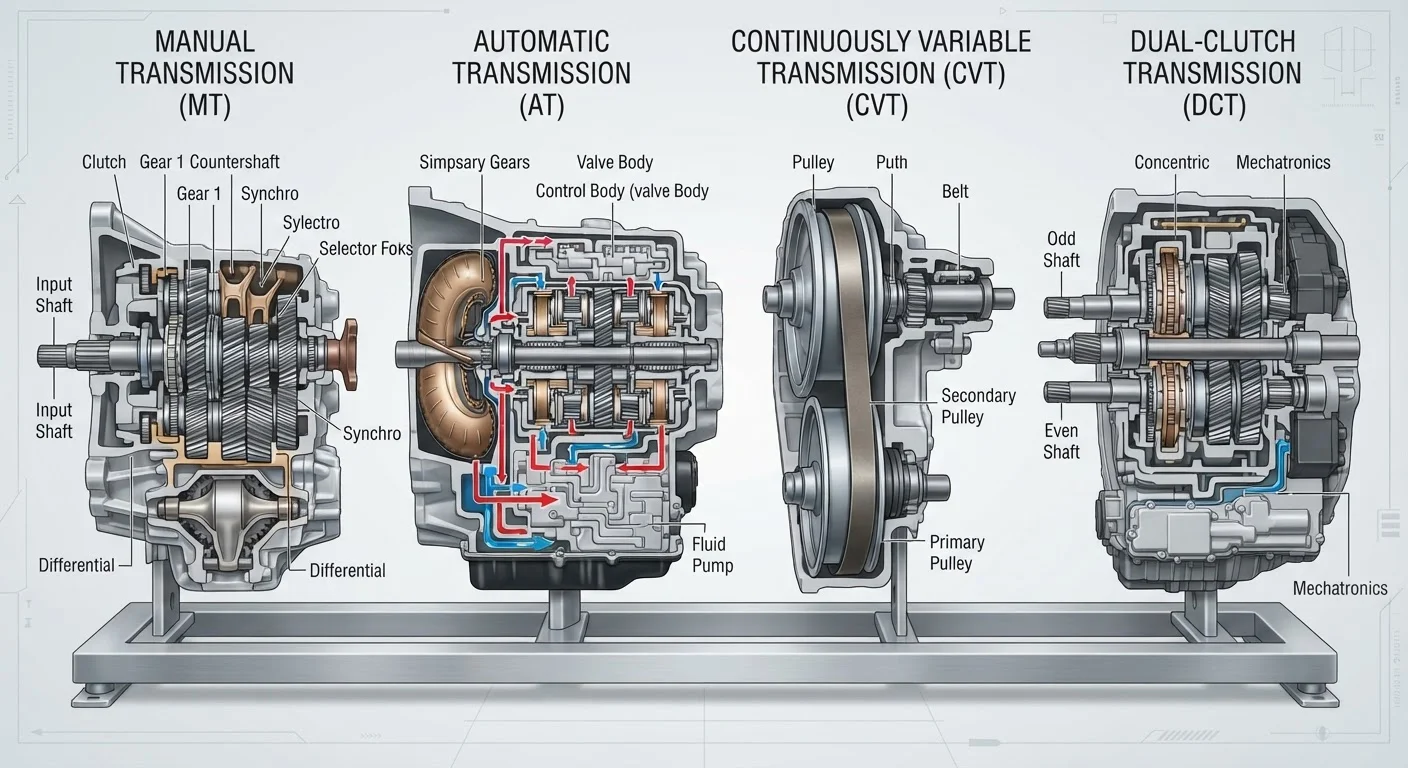
Photo: AnswersVista.com | Trustworthy Information Every Day editorial
Key Takeaways
- Manual transmissions give drivers direct gear control but require a learning curve and active clutch operation.
- Automatic transmissions shift on their own and remain the most common choice for everyday American drivers.
- CVTs use a belt-and-pulley system for seamless acceleration, often improving fuel efficiency.
- Dual-clutch transmissions combine manual-like efficiency with automatic-like convenience through two separate clutch packs.
- Transmission choice affects fuel economy, maintenance costs, and long-term reliability.
Why Your Transmission Type Matters
The transmission is the mechanical bridge between your engine and your wheels - it manages power delivery by selecting the right gear ratio for your speed and throttle input. The type you're driving shapes everything from how the car feels in traffic to how much you spend on upkeep over time.
Most drivers inherit a transmission with their vehicle purchase without fully understanding what it does. That gap in knowledge can lead to poor driving habits, deferred maintenance, or the wrong vehicle choice altogether. See our automotive glossary for definitions of any unfamiliar terms along the way. Understanding how each type works puts you firmly in the driver's seat - literally and figuratively.
The Four Main Transmission Types Compared
Here's how the four major transmission types stack up across the criteria most drivers care about:
| Manual | Automatic | CVT | Dual-Clutch | |
|---|---|---|---|---|
| Driver involvement | High - full gear control | Low - fully self-managing | Low - seamless, stepless | Medium - paddle shifts available |
| Fuel efficiency | Good when driven well | Good in modern units | Very good, optimized RPM | Very good, minimal power loss |
| City traffic usability | Tiring in heavy stop-go | Excellent | Excellent | Can feel jerky at low speed |
| Shift feel | Direct and mechanical | Smooth, progressive | Seamless, no steps | Fast and sporty |
| Typical maintenance | Clutch wear; fluid changes | Fluid changes | Fluid changes; sensitive to neglect | Fluid changes; complex repairs |
| Common vehicle types | Sports cars, economy cars | SUVs, trucks, most cars | Sedans, hybrids, compact cars | Sports cars, performance sedans |
Each transmission category has real trade-offs, and the right fit depends heavily on how and where you drive.
Manual: The Driver's Choice
A manual transmission (also called a stick shift) requires the driver to depress a clutch pedal and physically select gears using a gearshift. The clutch disengages the engine from the drivetrain momentarily, allowing a smooth gear change without grinding the gears.
Manuals are mechanically simpler than their automatic counterparts, which generally means lower repair costs when something does go wrong. However, the clutch itself is a wear item - aggressive city driving or a heavy-handed learning period can accelerate clutch wear significantly. Manuals also demand full driver attention, making them less appealing in heavy stop-and-go traffic.
Learning Manual? Start on Flat Ground
Automatic: Effortless and Everywhere
The automatic transmission selects gears on your behalf using a hydraulic torque converter and a set of planetary gear sets. Modern automatics - many offering six, eight, or even ten forward speeds - are highly refined, fuel-efficient, and smooth.
For most American drivers, the automatic is the default and for good reason. It handles varied driving conditions gracefully, reduces fatigue in commuter traffic, and requires no special skill to operate. Maintenance typically involves periodic fluid changes; neglecting transmission fluid is one of the more common and costly oversights drivers make. Overall ownership costs connect back to routine upkeep - see our overview of car ownership costs for a broader picture.
CVT: Smooth Power, Better Efficiency
A continuously variable transmission (CVT) replaces fixed gear steps with a belt-and-pulley system that adjusts ratio continuously across an infinite range. The result is seamless acceleration without the perceptible shift points you feel in a traditional automatic.
CVTs are particularly common in fuel-efficient sedans and hybrid vehicles because they keep the engine operating near its most efficient RPM range more consistently. The trade-off is a distinctive sound: under hard acceleration, the engine revs high and stays there - a sensation some drivers find unsettling compared to a traditional transmission's step-up pattern. CVT fluid maintenance is also important; these units can be sensitive to fluid degradation.
Don't Skip CVT Fluid Changes
Dual-Clutch: The Performance Middle Ground
A dual-clutch transmission (DCT) uses two separate clutch packs - one for odd gears, one for even - pre-selecting the next gear before you need it. This allows lightning-fast shifts with no interruption in power delivery, offering a driving experience closer to a manual in efficiency but with automatic-like convenience.
DCTs shine in performance contexts where rapid, precise gear changes matter. However, some designs have historically shown hesitation or jerkiness at low speeds - particularly during parking lot maneuvers - as the system struggles to smoothly manage the two clutches at crawling speeds. This characteristic varies by vehicle, so it's worth researching the specific unit in any vehicle you're considering. Understanding how drivetrain and transmission choices interact is also worth exploring - see our guide on drivetrain layouts for related context.
The content provided on our blog site traverses numerous categories, offering readers valuable and practical information. Readers can use the editorial team’s research and data to gain more insights into their topics of interest. However, they are requested not to treat the articles as conclusive. The website team cannot be held responsible for differences in data or inaccuracies found across other platforms. Please also note that the site might also miss out on various schemes and offers available that the readers may find more beneficial than the ones we cover.