
AWD, 4WD, FWD, and RWD: Choosing the Right Drivetrain for Your Conditions

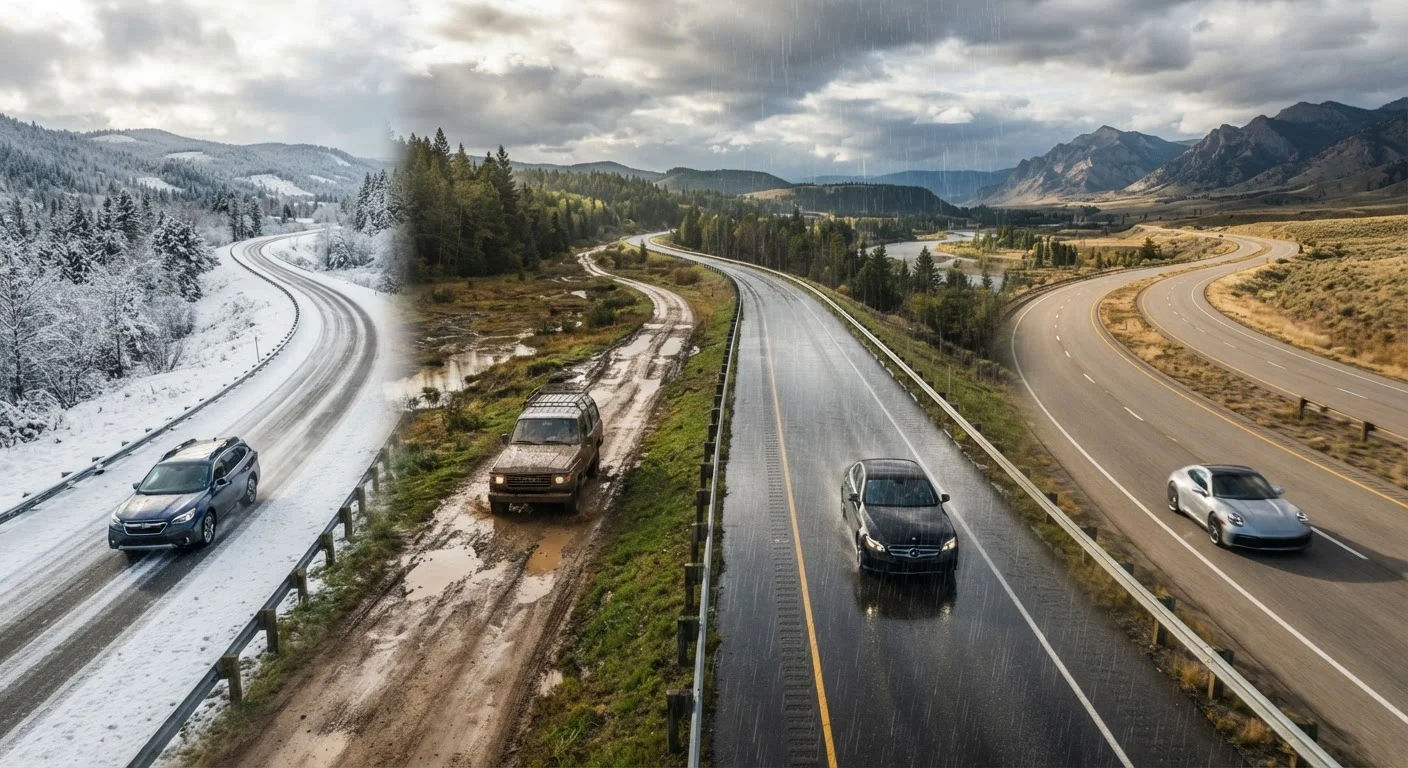
Photo: AnswersVista.com | Trustworthy Information Every Day editorial
Key Takeaways
- AWD and 4WD both send power to all four wheels but are engineered for different driving scenarios.
- FWD is efficient and capable in light snow, making it the most common layout for everyday passenger cars.
- RWD offers strong handling balance but demands more skill on slippery surfaces.
- No drivetrain system substitutes for quality tires matched to your local conditions.
What Drivetrain Actually Does
A drivetrain - sometimes called a powertrain layout - determines which wheels receive engine power. This directly affects how your vehicle accelerates, corners, and recovers traction when road conditions turn difficult. Understanding the four main configurations helps you evaluate whether a vehicle is well-suited to your real-world driving environment, not just its spec sheet. For a broader look at how mechanical systems interact, see the complete owner's roadmap.
The four layouts are front-wheel drive (FWD), rear-wheel drive (RWD), all-wheel drive (AWD), and four-wheel drive (4WD). Each delivers power differently, and each involves engineering trade-offs in traction, efficiency, cost, and driver feel.
Breaking Down Each Drivetrain
Front-Wheel Drive (FWD) sends engine power to the front axle, which both steers and propels the vehicle. This layout is mechanically compact and fuel-efficient, which is why it dominates mainstream sedans, hatchbacks, and crossovers. FWD performs reasonably well in light snow and rain because the weight of the engine sits directly over the driven wheels, improving grip during acceleration. The trade-off is that asking the front tires to steer and accelerate simultaneously can limit handling precision, especially in spirited driving.
Rear-Wheel Drive (RWD) routes power to the rear axle, freeing the front wheels to focus solely on steering. This separation of duties produces more balanced handling, which is why RWD remains standard on many performance cars and trucks. On dry pavement, RWD feels responsive and natural. In snow or ice, however, the rear can step out unpredictably under acceleration, requiring a more experienced hand - or a set of dedicated winter tires.
All-Wheel Drive (AWD) powers all four wheels simultaneously, with the system automatically distributing torque where grip is best detected. Modern AWD is largely seamless - most drivers never manually engage it. It excels in mixed or unpredictable conditions: wet highways, patchy snow, and loose gravel. AWD adds mechanical complexity and weight, which can reduce fuel economy modestly compared to FWD equivalents.
Four-Wheel Drive (4WD) is the rugged sibling to AWD. It typically uses a transfer case that locks front and rear axles together for maximum low-speed traction - ideal for deep mud, sand, rocks, and steep terrain. Most 4WD systems offer selectable modes (2H, 4H, 4L), and the low-range setting provides enormous torque multiplication for serious off-road situations. Using 4WD on dry pavement can stress drivetrain components, so it's generally reserved for low-traction surfaces.
| FWD | RWD | AWD | 4WD | |
|---|---|---|---|---|
| Best road condition | Wet/light snow | Dry pavement | Mixed/all-season | Off-road/deep snow |
| Fuel efficiency | Highest | Moderate | Lower than FWD | Lowest |
| Driver engagement | Low | High | Moderate | Moderate |
| Towing capability | Limited | Moderate | Moderate | High |
| System complexity | Simple | Simple | Complex | Most complex |
| Typical use case | Daily commuting | Performance/sport | All-weather utility | Off-road/work trucks |
Matching Drivetrain to Your Conditions
Geography and driving habits matter more than any single spec. If you live in a Sun Belt city and drive paved roads year-round, FWD or RWD will likely serve you well. If you commute through mountain passes or deal with months of winter weather, AWD's automatic traction management delivers meaningful real-world confidence. If you regularly haul a trailer, go overlanding, or navigate unpaved rural terrain, 4WD's low-range capability is genuinely useful - not just marketing.
Winter Tires Trump Drivetrain Every Time
One point worth emphasizing: no drivetrain system compensates for worn or mismatched tires. An AWD vehicle on all-season tires will stop slower on ice than a FWD vehicle fitted with winter tires. Traction begins at the contact patch between rubber and road. See our guide on tire maintenance for practical guidance on tread depth, pressure, and seasonal swaps.
Drivetrain also interacts with how you use your vehicle. Aggressive acceleration habits stress drivetrain components over time - something our wear-accelerating habits article explores in detail. And if drivetrain terminology sends you to the glossary, our car care glossary covers the terminology you'll encounter at the shop.
Cost and Efficiency Considerations
Drivetrain choice has a measurable impact on what you'll spend over time. AWD and 4WD systems add weight and mechanical complexity, typically increasing purchase price and reducing fuel economy compared to equivalent FWD models. Maintenance costs are also generally higher: additional differentials, transfer cases, and driveshafts all require periodic service. RWD vehicles sit in the middle - simpler than AWD but with a driveshaft running to the rear axle. FWD tends to be the most cost-efficient layout overall, both upfront and in long-term service.
Pairing your drivetrain choice with the right transmission type also shapes the driving experience. Our transmission types breakdown explains how manual, automatic, CVT, and dual-clutch options interact with power delivery - useful context when evaluating a vehicle as a complete package.
The content provided on our blog site traverses numerous categories, offering readers valuable and practical information. Readers can use the editorial team’s research and data to gain more insights into their topics of interest. However, they are requested not to treat the articles as conclusive. The website team cannot be held responsible for differences in data or inaccuracies found across other platforms. Please also note that the site might also miss out on various schemes and offers available that the readers may find more beneficial than the ones we cover.