
Home Workouts vs. Gym Memberships: Weighing the Trade-offs Honestly

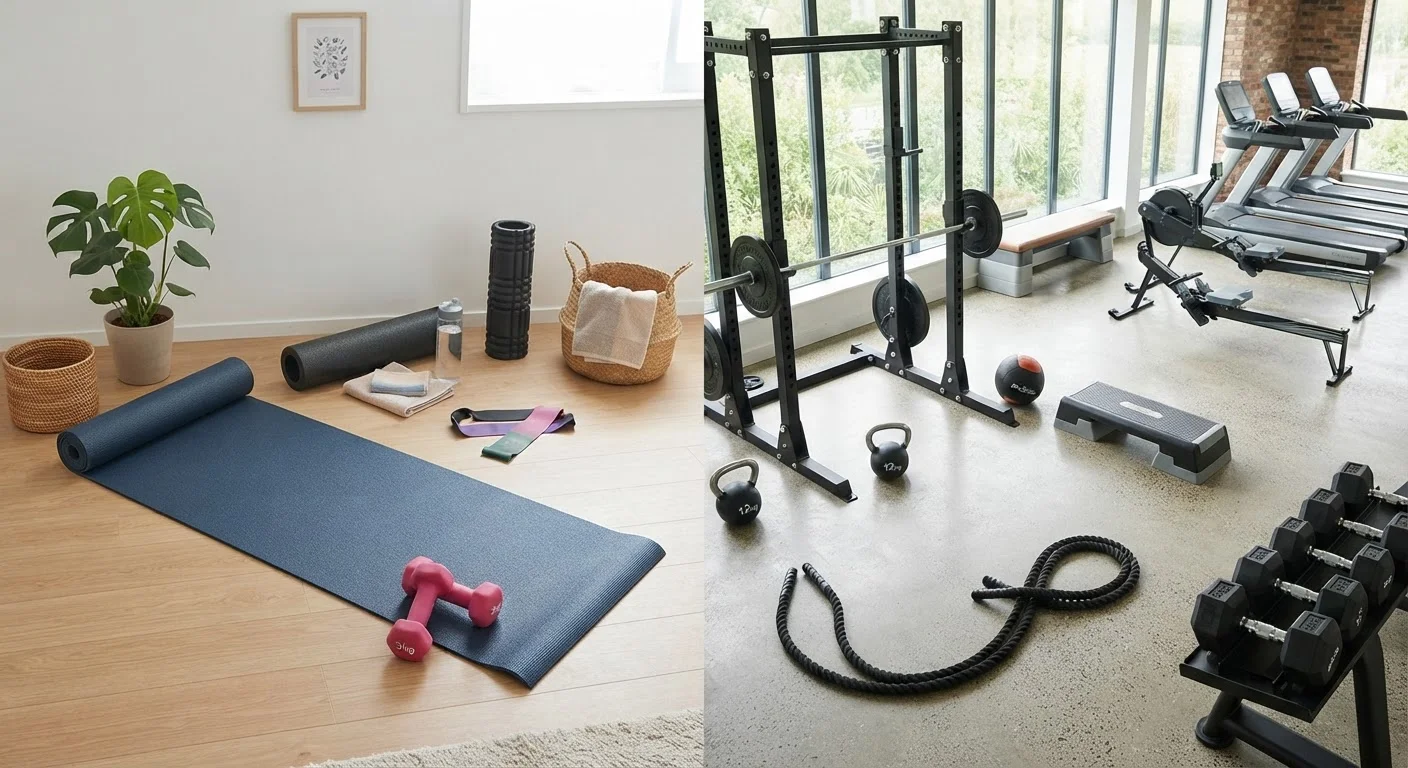
Photo: AnswersVista.com | Trustworthy Information Every Day editorial
Key Takeaways
- Home workouts eliminate commute time and membership costs but may limit equipment variety and social accountability.
- Gym memberships offer professional equipment, classes, and coaching that are difficult to replicate at home.
- Consistency - not location - is the strongest predictor of long-term fitness benefits.
- Your lifestyle, budget, and fitness goals should drive the choice, not popular opinion.
- A hybrid approach combining both options works well for many people.
The Real Question Isn't Which Is Better
Fitness culture tends to draw sharp lines - you're either a gym person or you work out at home. In practice, neither setting has a monopoly on results. What actually determines whether exercise improves your health is whether you do it consistently over time, not where you do it.
That said, the practical differences between home and gym training are real and worth examining honestly. Cost, equipment, motivation, and flexibility each play out differently depending on the setting. Understanding those trade-offs helps you make a choice that fits your actual life - not an idealized version of it. If you've also absorbed some popular beliefs about what makes exercise effective, it's worth checking those assumptions against the evidence first. Movement myths that keep people out of the gym are surprisingly common and often shape decisions before you even step foot in either place.
What Home Workouts Actually Offer
The clearest advantages of working out at home are convenience and cost. Eliminating a commute removes one of the most commonly cited barriers to exercise. There are no membership fees, no wait times for equipment, and no social pressure - which some people find genuinely freeing rather than isolating.
Bodyweight training, resistance bands, and relatively affordable free weights can support a broad range of fitness goals, including cardiovascular health, muscular strength, and flexibility. For people building or rebuilding a movement habit, the low barrier to entry is significant. Starting exercise after a long break often goes more smoothly in a low-pressure home environment.
The honest limitations: space constraints can restrict certain exercises, and without professional guidance, there's a higher risk of developing poor form or hitting a plateau without recognizing it. Motivation can also drift without external structure or accountability.
Start With What You'll Actually Do
What a Gym Membership Adds
Gyms provide access to equipment - cables, weighted machines, barbells, cardio machines - that most home setups can't match economically. For goals like heavy strength training, sport-specific conditioning, or trying a wide variety of movement styles, this breadth matters.
Group fitness classes offer structured programming and a social dimension that research suggests can support consistency. Access to personal trainers or certified instructors is another factor, particularly for people learning foundational movement patterns or managing a chronic condition. Anyone managing joint concerns or limited mobility may especially benefit from professional programming - low-impact exercise options are easier to learn and adapt with qualified support nearby.
The trade-offs are equally real: memberships carry monthly costs, gyms require travel, peak hours create crowding, and some people find the environment uncomfortable or intimidating - none of which helps consistency.
| Home Workouts | Gym Membership | |
|---|---|---|
| Upfront / Ongoing Cost | Low monthly cost; upfront equipment spend varies | Recurring monthly or annual fee required |
| Convenience | No commute; available any time | Requires travel; limited by hours |
| Equipment Variety | Limited by space and budget | Broad access to machines and free weights |
| Professional Guidance | Self-directed; online resources available | Trainers and classes often on-site |
| Social Accountability | Lower by default; requires effort to create | Built-in via classes and gym community |
| Barrier to Entry | Very low; easy to start quickly | Moderate; requires enrollment and commute |
| Best Suited For | General fitness, habit-building, flexibility | Strength goals, specialized training, variety |
How to Think About the Decision
Rather than asking which option is universally better, consider which factors carry the most weight in your situation. A gym's social energy might be exactly what keeps one person going, while for another it's the friction that stops them from showing up. Neither reaction is wrong.
Budget matters practically. Gym memberships in the U.S. vary widely - from budget-tier options under $30 a month to premium facilities several times that cost. Home equipment involves upfront costs but no ongoing fees. Both approaches can be financially sustainable depending on what you choose.
Your specific fitness goals also shape the equation. If building significant muscular strength or training for an event is the priority, gym access typically offers more tools to get there. If the goal is general movement, stress reduction, and staying active - all well-established contributors to long-term health - a consistent home routine is entirely capable of delivering that.
For a closer look at how different types of exercise affect your body, see our piece on strength training vs. cardio - it helps clarify what each mode actually does physiologically, which matters for deciding which equipment and setting you actually need.
This article is for general informational and educational purposes only and is not a substitute for professional medical advice. Consult a qualified healthcare provider before beginning any new exercise program, especially if you have an existing health condition.
The content provided on our blog site traverses numerous categories, offering readers valuable and practical information. Readers can use the editorial team’s research and data to gain more insights into their topics of interest. However, they are requested not to treat the articles as conclusive. The website team cannot be held responsible for differences in data or inaccuracies found across other platforms. Please also note that the site might also miss out on various schemes and offers available that the readers may find more beneficial than the ones we cover.