
Dietary Fat: Saturated, Unsaturated, and Trans Fats Compared

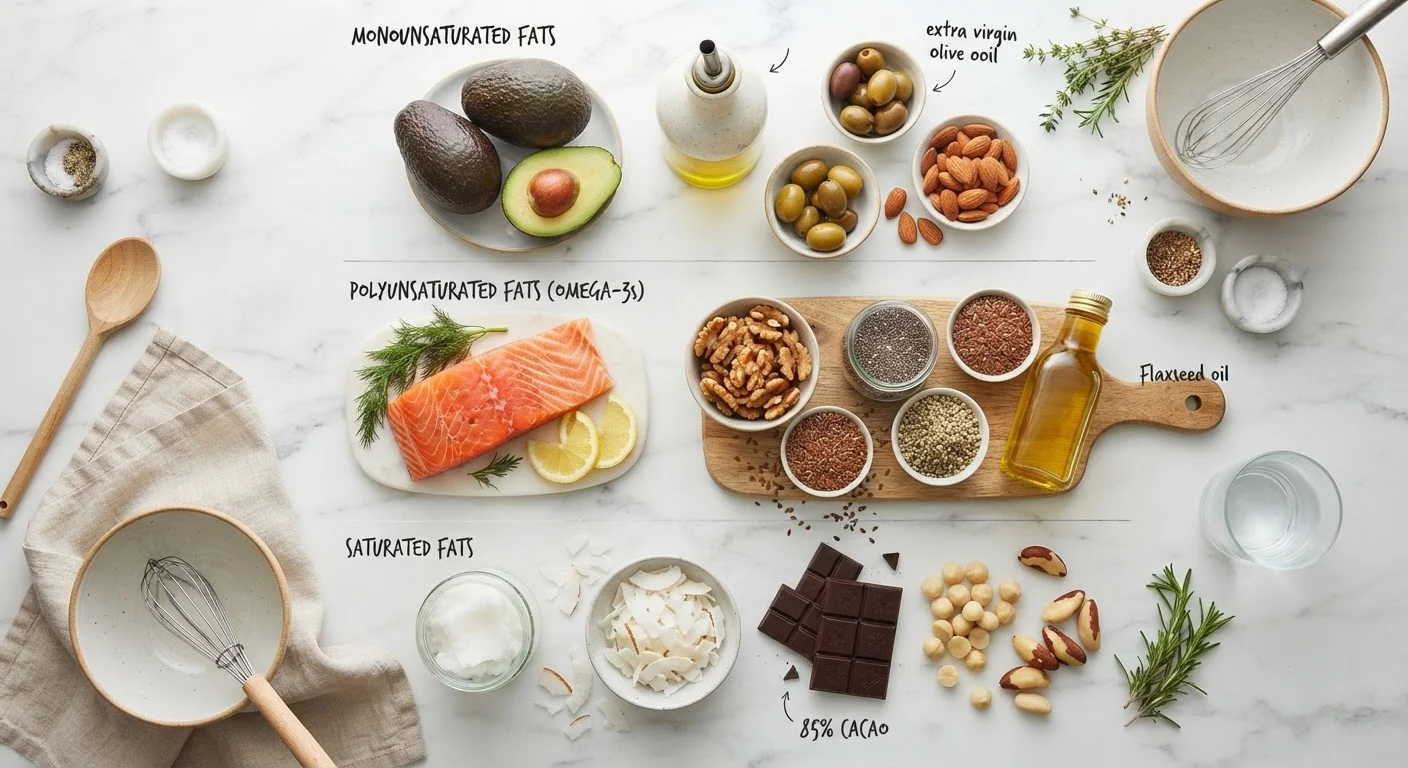
Photo: AnswersVista.com | Trustworthy Information Every Day editorial
Key Takeaways
- Dietary fat is an essential macronutrient; eliminating it entirely is neither safe nor necessary.
- Unsaturated fats - found in plants and fish - are broadly associated with cardiovascular health benefits.
- Saturated fat's health impact is nuanced; current research suggests moderation rather than elimination.
- Artificial trans fats have been largely banned in the US due to well-documented cardiovascular risks.
- Food context matters: focus on overall dietary patterns rather than single nutrients in isolation.
Why Dietary Fat Matters
Fat is one of the three primary macronutrients your body requires to function. It supports cell membrane integrity, enables absorption of fat-soluble vitamins (A, D, E, and K), cushions vital organs, and supplies a concentrated source of energy. For a broader view of how fat fits alongside carbohydrates and protein, see our guide to macronutrients and micronutrients.
The key distinction isn't whether to eat fat - it's which kinds and in what proportions. Decades of nutrition research have progressively refined how scientists and health organizations classify and evaluate dietary fats, moving away from blanket low-fat messaging toward a more nuanced understanding of fat quality.
~34%
Share of US calories from total fat
According to USDA dietary survey data, total fat intake among American adults represents roughly a third of average daily caloric consumption.
2018
Year WHO called for global trans fat elimination
The World Health Organization launched its REPLACE initiative in 2018, aiming to eliminate industrially produced trans fats from the global food supply by 2023.
Saturated Fat: The Complicated Middle Ground
Saturated fats are solid at room temperature and found predominantly in animal products - red meat, butter, full-fat dairy - as well as tropical oils like coconut and palm oil. They're called "saturated" because their carbon chains are fully loaded with hydrogen atoms, making them chemically stable and resistant to oxidation.
For decades, saturated fat was considered a primary driver of cardiovascular disease due to its ability to raise low-density lipoprotein (LDL) cholesterol. Current research has complicated this picture. While high saturated fat intake remains associated with elevated LDL in many studies, the overall effect on cardiovascular risk appears to depend on what replaces it in the diet. Swapping saturated fat for refined carbohydrates, for instance, shows little benefit; swapping it for unsaturated fats appears more favorable.
Major health organizations, including the American Heart Association, generally recommend limiting saturated fat to around 5-6% of total daily calories for those managing cardiovascular risk - but any individual guidance should come from a qualified healthcare provider.
Swap, Don't Just Cut
Unsaturated Fat: The Well-Supported Option
Unsaturated fats contain one or more double bonds in their carbon chains, making them liquid at room temperature. They divide into two main families:
- Monounsaturated fats (MUFAs): Found in olive oil, avocados, most nuts, and canola oil. Associated in research with modestly improved LDL and HDL cholesterol profiles.
- Polyunsaturated fats (PUFAs): Include omega-3 and omega-6 fatty acids. Omega-3s - found in fatty fish, flaxseed, and walnuts - have the most robust evidence for cardiovascular and anti-inflammatory benefits. Omega-6s appear in vegetable oils like corn and soybean oil.
The Mediterranean dietary pattern, which emphasizes olive oil, fish, legumes, and vegetables, is one of the most studied eating patterns associated with cardiovascular health - and unsaturated fats are central to it. Choosing whole-food sources of these fats tends to deliver additional nutritional value compared to refined oils alone. Our overview of whole foods versus processed foods explores why food context makes a meaningful difference.
Trans Fat: The Clear Outlier
Trans fats come in two forms. Small amounts occur naturally in ruminant animal products (beef, lamb, dairy), but the more consequential type - artificial trans fat - was created industrially through partial hydrogenation of vegetable oils. This process produced shelf-stable, economical fats widely used in processed snacks, margarines, and fried foods through much of the 20th century.
The evidence against artificial trans fats is unusually consistent: they raise LDL cholesterol, lower HDL ("good") cholesterol, and are associated with increased cardiovascular risk. The US Food and Drug Administration (FDA) determined in 2015 that partially hydrogenated oils - the main source of artificial trans fats - were no longer "generally recognized as safe," and phased them out of the US food supply by 2020.
Consumers can still encounter small amounts in products using older formulations or in naturally occurring trace amounts in animal-derived foods. Reading ingredient labels for "partially hydrogenated oil" remains a useful habit.
| Saturated Fat | Monounsaturated Fat | Polyunsaturated Fat | Artificial Trans Fat | |
|---|---|---|---|---|
| Physical state at room temp | Solid | Liquid | Liquid | Solid or semi-solid |
| Common food sources | Butter, red meat, coconut oil | Olive oil, avocado, almonds | Fatty fish, walnuts, flaxseed | Partially hydrogenated oils (largely phased out) |
| Effect on LDL cholesterol | May raise LDL | Neutral or modest decrease | Generally lowers LDL | Significantly raises LDL |
| Effect on HDL cholesterol | May raise HDL | May modestly raise HDL | Variable by omega type | Lowers HDL |
| Current US regulatory status | Permitted; moderate intake advised | Permitted; widely recommended | Permitted; widely recommended | Artificial type banned by FDA (2020) |
| Research consensus | Nuanced; context-dependent | Broadly favorable | Broadly favorable (esp. omega-3) | Clearly unfavorable |
Putting It Together: Practical Perspective
Nutrition science increasingly emphasizes dietary patterns over isolated nutrients. A diet built around vegetables, legumes, whole grains, fatty fish, and minimally processed foods will naturally feature more unsaturated fat, moderate saturated fat from whole sources, and negligible artificial trans fat - without requiring obsessive nutrient tracking.
Fat quantity matters too. All dietary fats supply roughly 9 calories per gram, making them calorie-dense. Overconsumption of any fat type - however healthy - can contribute to excess caloric intake. Balance across the overall diet is the practical goal.
For those with existing heart disease, diabetes, high cholesterol, or other conditions, personalized guidance from a registered dietitian or physician is essential. This article provides general nutrition education and is not a substitute for medical or dietary advice.
Pair awareness of dietary fat with understanding of other key nutrients - fiber is another area where many Americans fall short. Our fiber nutrition guide covers why it matters and how to get more of it through everyday foods.
This article is for general informational and educational purposes only and does not constitute medical or dietary advice. Consult a qualified healthcare professional for guidance specific to your health needs.
The content provided on our blog site traverses numerous categories, offering readers valuable and practical information. Readers can use the editorial team’s research and data to gain more insights into their topics of interest. However, they are requested not to treat the articles as conclusive. The website team cannot be held responsible for differences in data or inaccuracies found across other platforms. Please also note that the site might also miss out on various schemes and offers available that the readers may find more beneficial than the ones we cover.