
Insulation R-Values: What the Numbers Actually Mean for Your Home

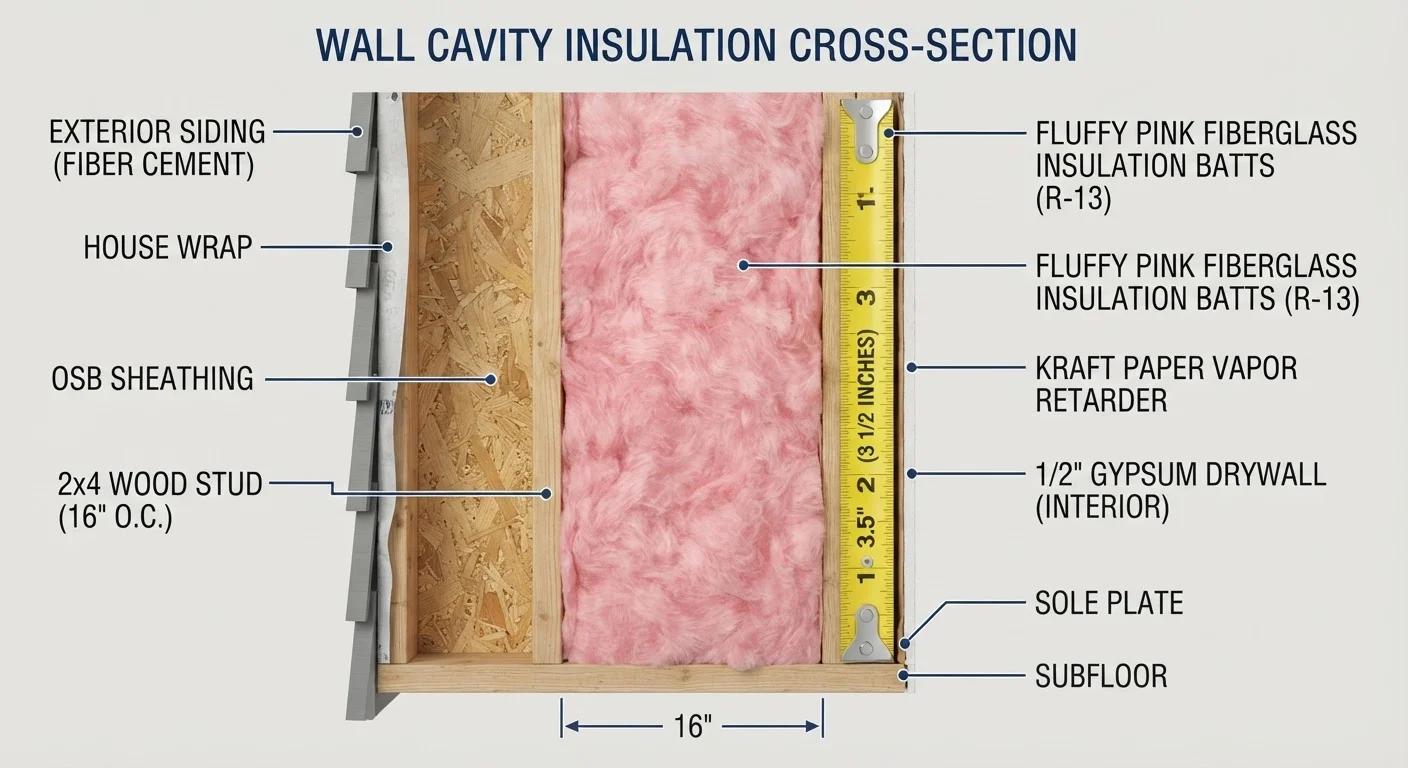
Photo: AnswersVista.com | Trustworthy Information Every Day editorial
Key Takeaways
- Higher R-values indicate greater resistance to heat transfer and better insulation performance.
- The right R-value for your home depends on your climate zone, not just material type.
- Attics typically require the highest R-values because heat rises and escapes most easily through roofs.
- Compressing insulation batts reduces their effective R-value - proper installation matters as much as the product.
- Air sealing and insulation work together; insulation alone cannot stop drafts.
How R-Value Actually Works
When your furnace runs, it's fighting a constant battle against heat escaping through your walls, ceiling, and floors. R-value quantifies how hard your insulation makes that battle for the heat trying to escape. A material rated R-15 resists heat flow roughly twice as effectively as one rated R-7.
Two key principles are worth internalizing. First, R-values are additive: if you install R-13 batts in a wall cavity and then add R-5 rigid foam to the exterior, you get an effective R-18 assembly - assuming correct installation with no gaps. Second, R-value only describes conductive resistance. It tells you nothing about how well a material stops air movement, which is a separate (and equally important) problem.
R-Value vs. Whole-Wall Performance
Climate Zones and Why Location Changes Everything
The U.S. Department of Energy divides the country into eight climate zones, and the recommended R-values vary substantially across them. A home in Phoenix (Zone 2) has very different insulation needs than one in Minneapolis (Zone 6). In warmer zones, the focus shifts toward keeping heat out during summer; in colder zones, retaining heat in winter is the dominant concern.
General ranges from DOE guidance give a useful starting framework:
- Attics: R-30 to R-60 depending on zone
- Cathedral ceilings: R-22 to R-49
- Floors over unconditioned spaces: R-13 to R-30
- Exterior walls: R-13 to R-21 in most climates
These are guidelines, not code requirements - local building codes may specify minimums that differ. Always verify what applies in your municipality before beginning a project.
R-49 to R-60
Recommended attic R-value for cold climates
According to U.S. Department of Energy climate zone guidance for Zones 5-8, covering most of the northern United States.
~15%
Heat lost through an under-insulated attic
The U.S. DOE estimates that heating and cooling account for about half of home energy use, with the attic being a primary loss point in under-insulated homes.
R-6 to R-7
Per-inch R-value of closed-cell spray foam
Closed-cell spray polyurethane foam offers the highest R-value per inch of commonly available insulation materials, per DOE material comparisons.
Material Type and Real-World Performance
Different insulation materials achieve their R-values in different ways, and choosing the right one depends on where it's going and how much space you have.
- Fiberglass batts
- Roughly R-2.9 to R-3.8 per inch. Common in walls and attics; must fit cavity tightly without compression.
- Blown-in cellulose
- Around R-3.2 to R-3.8 per inch. Excellent for attic floors and hard-to-reach spaces; settles slightly over time.
- Spray polyurethane foam (closed-cell)
- Approximately R-6 to R-7 per inch - the highest per-inch rating of common materials. Also acts as an air and vapor barrier.
- Rigid foam board
- R-3.8 to R-6.5 per inch depending on type. Often used on exterior walls or basement walls where space is limited.
Higher per-inch R-value matters most in constrained spaces - a 2x4 wall cavity only offers about 3.5 inches of depth, making material choice directly relevant to how much thermal resistance you can realistically achieve.
Installation Quality: Where R-Values Get Lost
The number printed on insulation packaging assumes ideal installation. In practice, two common mistakes erode performance significantly.
Compression is the most prevalent issue with batt insulation. Squeezing an R-15 batt into a space that's too shallow reduces its effective R-value - sometimes dramatically. Always match batt thickness to cavity depth.
Gaps and voids around wiring, pipes, and framing members create thermal bypasses. Even a small uncovered area in an attic can allow disproportionate heat loss. Cutting batts carefully and filling odd-shaped cavities with cut pieces or spray foam matters.
It's also worth remembering that insulation and air sealing are complementary, not interchangeable. Gaps around recessed lights, attic hatches, and plumbing stacks allow conditioned air to escape regardless of how much insulation surrounds them. For a full picture of where your home loses energy through air movement, see our guide to sealing air leaks.
Prioritize Attic Insulation First
Frequently Asked Questions
The content provided on our blog site traverses numerous categories, offering readers valuable and practical information. Readers can use the editorial team’s research and data to gain more insights into their topics of interest. However, they are requested not to treat the articles as conclusive. The website team cannot be held responsible for differences in data or inaccuracies found across other platforms. Please also note that the site might also miss out on various schemes and offers available that the readers may find more beneficial than the ones we cover.