
Digital Clutter vs. Physical Clutter: Two Kinds of Disorder, One Shared Cause

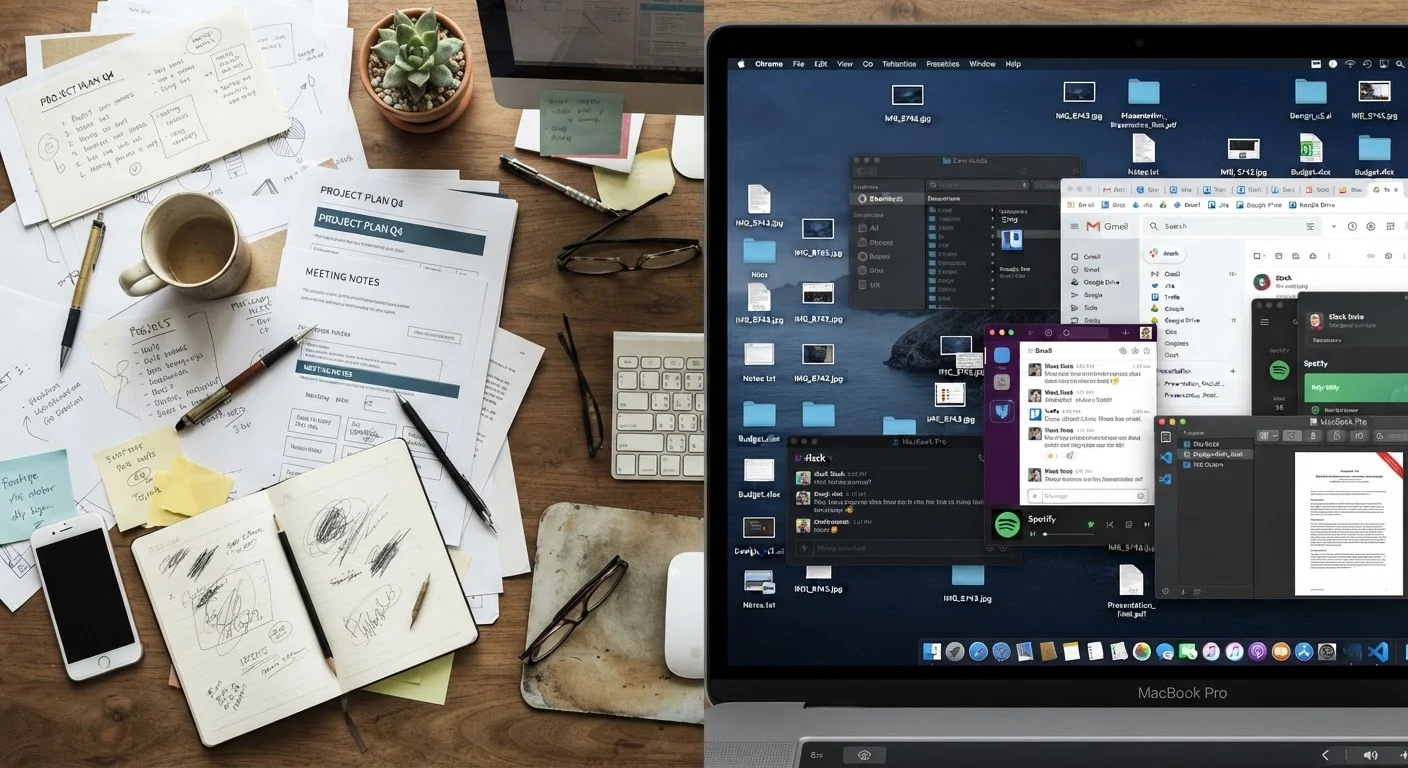
Photo: AnswersVista.com | Trustworthy Information Every Day editorial
Key Takeaways
- Both digital and physical clutter stem from the same core habit: delayed decisions about what to keep.
- Digital clutter is harder to notice because it has no visual weight, but its cognitive cost is just as real.
- Clearing either type of clutter requires a system, not just a one-time purge.
- The organizational principles that work for physical spaces translate directly to digital environments.
- Tackling both simultaneously can reinforce better habits across all areas of your life.
The Same Problem, Two Different Surfaces
Most people treat a chaotic Downloads folder and a cluttered kitchen counter as entirely separate problems. They're not. Both are symptoms of the same underlying pattern: things entering a space faster than decisions are made about them.
Physical clutter accumulates when items land somewhere temporarily and never get assigned a permanent home. Digital clutter works identically - screenshots pile up, email subscriptions go unchecked, and app libraries bloat because deleting feels like a decision that can wait. The surface is different; the mechanism is the same.
Understanding this shared cause matters because it means the same thinking that helps you organize a room can help you organize a hard drive. The psychology behind clutter applies whether you can see the mess or not.
| Criterion | Digital Clutter | Physical Clutter |
|---|---|---|
| Visibility | Hidden; easy to ignore | Visible; harder to ignore |
| Accumulation speed | Very fast; passive and automatic | Slower; requires physical acquisition |
| Emotional weight | Usually low | Often high; tied to memory and identity |
| Immediate stress impact | Cognitive; harder to pinpoint | Visual; felt quickly |
| Space occupied | Storage and memory; no floor space | Physical floor and surface area |
| Maintenance approach | Scheduled digital sweeps and rules | Regular tidying and one-in-one-out habits |
| Primary decluttering challenge | Volume and repetition | Emotional decision-making |
What Makes Digital Clutter Uniquely Sneaky
Physical clutter has a visibility advantage - you can see a pile growing on your desk, which triggers at least some impulse to act. Digital clutter offers no such visual alarm. A desktop with 400 icons and one with 40 look equally functional until you need to find something specific.
This invisibility allows digital disorder to compound silently. Duplicate photos don't take up floor space. Forgotten subscriptions don't block a doorway. But they do tax your device's performance, your mental bandwidth, and occasionally your budget when recurring charges go unnoticed.
Digital clutter also arrives faster. A single afternoon of browsing can generate dozens of browser tabs, saved articles, downloaded PDFs, and new account sign-ups. No single shopping trip fills your home that quickly.
28%
of work time spent searching for information
Research from IDC has estimated that knowledge workers spend roughly a quarter of their workday looking for documents and information - a figure digital clutter directly worsens.
~10 min
lost daily to physical clutter searches
Studies in organizational psychology suggest people spend an average of around 10 minutes per day searching for misplaced physical items in home environments.
2x
faster email inbox growth vs. deletion habits
Analysis of email behavior patterns consistently shows that most users receive and retain significantly more messages than they actively process or delete each week.
Side-by-Side: How the Two Types Compare
While both types share a root cause, they differ meaningfully in how they show up and how you address them. Recognizing those differences helps you apply the right strategy to each.
Physical decluttering often demands more emotional energy - letting go of objects tied to memories or identity is genuinely harder than deleting a file. Digital decluttering, by contrast, tends to be more tedious than emotional: sorting thousands of emails or renaming hundreds of files is repetitive work that benefits from scheduled, focused sessions rather than inspiration.
For physical spaces, a room-by-room audit is one of the most practical starting points. For digital spaces, the equivalent is an account-by-account audit: email, cloud storage, subscriptions, and devices reviewed in turn.
Shared Principles That Work for Both
Because the causes overlap, so do the solutions. These principles apply whether you're clearing a closet or a cloud drive:
- One-touch decisions: Handle each item once - file it, delete it, or give it a designated place. Deferring creates the pile.
- Designated homes: Every physical object and every digital file type should have a defined location. Ambiguity is clutter's best friend.
- Regular maintenance windows: Neither space stays organized without periodic upkeep. A monthly 20-minute digital sweep mirrors what a weekly tidy does for a room.
- Friction reduction: Make organizing easier than not organizing. Clear folder names, accessible storage, and simple labeling systems lower the barrier to putting things where they belong.
If you find that spaces - physical or digital - revert to disorder quickly, the issue is usually a missing system rather than a lack of effort. Why spaces get disorganized again often traces back to this same gap. Exploring established decluttering methods can help you find a framework that fits your decision-making style for physical items, and the underlying logic adapts surprisingly well to digital environments too.
Starting Small Still Counts
The content provided on our blog site traverses numerous categories, offering readers valuable and practical information. Readers can use the editorial team’s research and data to gain more insights into their topics of interest. However, they are requested not to treat the articles as conclusive. The website team cannot be held responsible for differences in data or inaccuracies found across other platforms. Please also note that the site might also miss out on various schemes and offers available that the readers may find more beneficial than the ones we cover.