
Index Funds and Everyday Investors: What the Basics Actually Mean

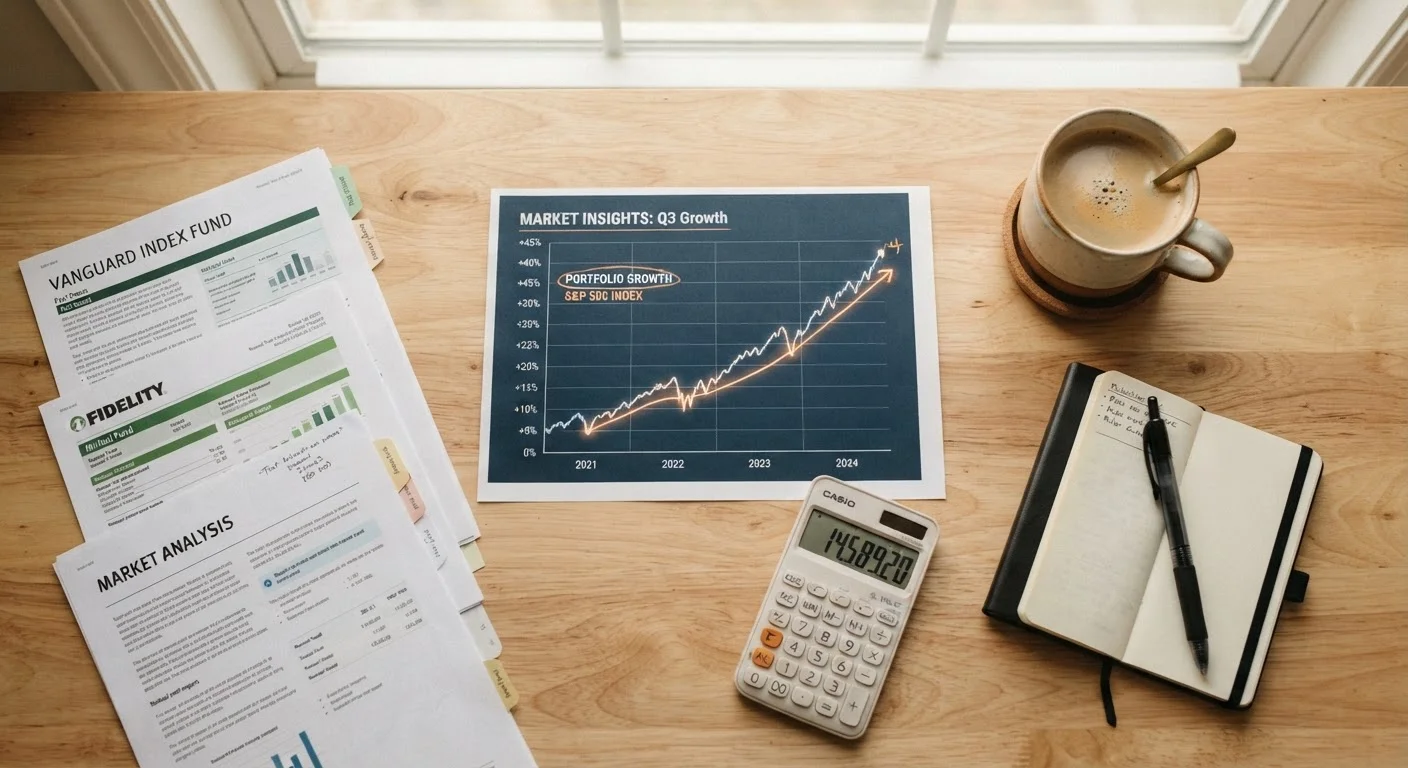
Photo: AnswersVista.com | Trustworthy Information Every Day editorial
Key Takeaways
- Index funds track a market benchmark rather than attempting to outperform it.
- Lower fees (expense ratios) are one of the most commonly cited advantages of index funds.
- By design, an index fund provides broad exposure to many companies at once.
- Index funds carry market risk - they decline in value when the broader market declines.
- They are commonly held inside tax-advantaged accounts like 401(k)s and IRAs.
- Past market performance does not guarantee future results for any investment.
Why Index Funds Come Up So Often
If you've spent any time reading about personal finance, you've almost certainly encountered a sentence like "just put it in an index fund." The advice is common - but the explanation behind it is often skipped. Understanding what an index fund actually does, and why it's structured the way it is, puts you in a much stronger position when making decisions about your own money.
At its core, the debate around index funds is a debate about two different philosophies: passive investing versus active investing. Active management means a professional fund manager studies the market, selects individual stocks, and tries to generate returns that beat the broader market. Passive investing - the approach index funds take - makes no such attempt. The fund simply holds what the index holds, in the same proportions. No predictions, no stock-picking.
~$10T+
Assets held in U.S. index funds
Index fund assets in the United States have grown substantially over the past two decades, reflecting broad adoption among both institutional and individual investors (Investment Company Institute, 2023).
~0.05%
Typical expense ratio for large index funds
Many broad-market index funds carry expense ratios well below 0.10%, compared to actively managed equity funds that have historically averaged closer to 0.60%-1.00% annually (Morningstar, 2023).
~80-90%
Active funds underperforming index over 15 years
According to S&P Dow Jones Indices' SPIVA scorecard, a large majority of actively managed U.S. equity funds have underperformed their benchmark index over rolling 15-year periods.
How an Index Fund Actually Works
Take the S&P 500 as an example. This index tracks approximately 500 of the largest publicly traded U.S. companies, weighted by market value. An S&P 500 index fund owns the same companies in roughly the same proportions. When a company's share price rises and its weight in the index increases, the fund adjusts accordingly. The goal is faithful replication - not superior performance.
This structure has a practical consequence: costs stay low. Actively managed funds pay analysts and portfolio managers to research and trade continuously. Index funds require far less human intervention, so their annual fees - known as expense ratios - tend to be substantially lower. According to data published by the Investment Company Institute, the average expense ratio for actively managed equity mutual funds has historically been several times higher than for passively managed index funds. Over a multi-decade holding period, that fee difference compounds into a meaningful dollar amount.
See how compounding affects long-term outcomes in our explanation of compounding interest.
What Index Funds Don't Do
Index funds don't protect you from market downturns. Because a broad-market index fund rises and falls with the overall market, a recession or market correction will reduce its value. This is a fundamental trade-off, not a flaw unique to index funds - virtually all investments carry some form of risk. But it's important to be clear-eyed about it.
They also don't offer flexibility in avoiding specific companies or sectors. If a particular industry is heavily represented in an index, you own it. Some investors find this acceptable; others may prefer funds that screen out certain sectors for ethical or strategic reasons. Those options exist, though they often come with their own trade-offs in cost or concentration.
For context on how index funds fit within a broader approach, our article on what diversification actually means clarifies how owning a single index fund compares to a truly diversified portfolio.
Check the Expense Ratio Before Selecting a Fund
Index Funds in the Context of Retirement Planning
Index funds are frequently used inside retirement accounts - 401(k)s, traditional IRAs, and Roth IRAs - precisely because their low costs and long holding periods tend to work well together. The tax-advantaged nature of these accounts also allows gains and dividends to grow without being taxed annually, which amplifies the low-cost benefit over time.
That said, the right mix of funds depends on factors specific to each person: age, income, timeline, risk tolerance, and other savings. An index fund tracking U.S. large-cap stocks behaves very differently from one tracking international stocks, bonds, or small-cap companies. Understanding the differences between account types is a useful first step - our retirement accounts explainer covers the key distinctions in plain language.
Index funds are a widely used tool, but they're one piece of a larger financial picture. For decisions tied to your specific situation, a licensed financial adviser or certified financial planner can help you determine what makes sense for your goals.
This article is for general informational and educational purposes only and does not constitute personalized financial, investment, tax, or legal advice. Investing involves risk, including the possible loss of principal. Past performance does not guarantee future results. Consult a qualified financial professional before making investment decisions.
Frequently Asked Questions
The content provided on our blog site traverses numerous categories, offering readers valuable and practical information. Readers can use the editorial team’s research and data to gain more insights into their topics of interest. However, they are requested not to treat the articles as conclusive. The website team cannot be held responsible for differences in data or inaccuracies found across other platforms. Please also note that the site might also miss out on various schemes and offers available that the readers may find more beneficial than the ones we cover.