
Short-Term Savings vs. Long-Term Investing: Knowing Which Tool Fits Which Goal

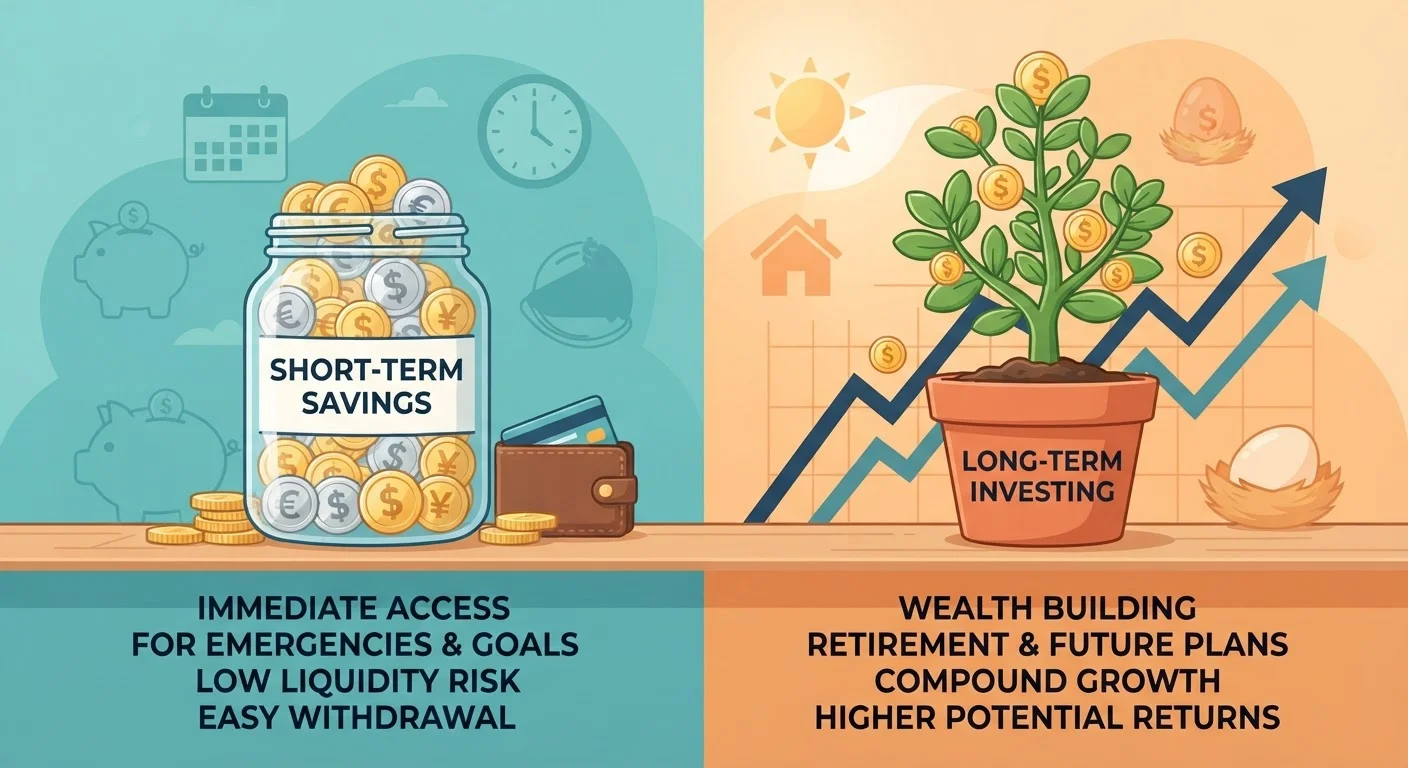
Photo: AnswersVista.com | Trustworthy Information Every Day editorial
Key Takeaways
- Timeline is the single most important factor in deciding between saving and investing.
- Short-term savings belong in low-risk, liquid accounts like high-yield savings or money market accounts.
- Long-term goals - especially retirement - generally benefit from market-based investing and compound growth.
- Most households need both tools running simultaneously, not one or the other.
- Putting money earmarked for near-term needs into investments exposes it to timing risk you can't afford.
Why the Question Isn't 'Save or Invest?'
Most personal finance conversations frame saving and investing as competing choices. They aren't. The more useful question is: which tool matches this specific goal? Using the wrong one - investing money you'll need in 18 months, or keeping retirement funds in a savings account for decades - creates real financial costs.
The core distinction comes down to two variables: timeline and risk tolerance relative to that timeline. Money needed soon must be safe and accessible. Money not needed for years can ride out market volatility and benefit from growth. Understanding that framework makes the decision largely mechanical.
It's also worth noting that most households need both approaches running at the same time. Avoiding common financial planning mistakes often comes down to correctly pairing goals with the right vehicle.
How Short-Term Savings Work - and When to Use Them
Short-term savings are designed for goals with a horizon of roughly one to three years. The defining features are capital preservation (your principal doesn't lose value) and liquidity (you can access the money quickly without penalty).
Common vehicles include high-yield savings accounts, money market accounts, and short-term certificates of deposit (CDs). These are not investment vehicles - they won't generate the growth needed to build long-term wealth, but that's not their job. Their job is to hold your money safely until you need it.
Appropriate uses include:
- Emergency funds (typically three to six months of essential expenses)
- A down payment you plan to use within two years
- A planned large purchase - car, home repair, vacation
- Predictable irregular expenses, sometimes called sinking funds
Protect Short-Term Goals From Market Timing Risk
For anything within a three-year window, the risk of loss in a volatile market almost always outweighs any potential upside from investing. Protecting the principal matters more than growing it.
How Long-Term Investing Works - and When to Use It
Investing involves placing money into assets - stocks, bonds, index funds, retirement accounts - that carry some risk of short-term loss but offer meaningful growth potential over time. The key enabling factor is a long enough time horizon to absorb downturns and benefit from compounding returns.
Compounding interest is the engine of long-term wealth: returns generate their own returns, and over decades, the effect becomes substantial. This is why starting early matters so much, even with small amounts.
Appropriate uses include:
- Retirement (401(k), IRA, Roth IRA) - typically a 20-40 year horizon
- College savings for young children
- Wealth building beyond your emergency fund baseline
For a structured look at the account types available, see retirement accounts decoded. And if you're weighing Roth versus traditional contributions, this side-by-side comparison can clarify the tax differences.
| Short-Term Savings | Long-Term Investing | |
|---|---|---|
| Typical time horizon | Under 3 years | 5+ years (often decades) |
| Primary goal | Preserve capital, maintain liquidity | Grow wealth over time |
| Risk level | Very low | Moderate to higher |
| Common vehicles | High-yield savings, money market, CDs | 401(k), IRA, index funds, brokerage |
| Inflation protection | Limited - often below inflation long-term | Stronger - historically outpaces inflation |
| Liquidity | High - funds accessible quickly | Lower - early withdrawal may mean penalties or losses |
| Best suited for | Emergency fund, near-term purchases | Retirement, college savings, wealth building |
This content is general financial education and is not personalized investment advice. Consider speaking with a licensed financial professional about your specific situation.
The Risk of Mismatching Goals and Tools
The most common mismatch runs in both directions. Some people invest money they'll need within a year - exposing short-term goals to market timing risk. If the market drops 20% the month before you need a down payment, you may have to delay your plans or take a loss. Short-term needs cannot afford that uncertainty.
The opposite error - keeping long-term money in a savings account indefinitely - is subtler but equally costly. Savings account rates rarely keep pace with inflation over decades, meaning the real purchasing power of that money shrinks over time. Someone holding retirement funds in a standard savings account for 30 years is effectively losing ground.
The math behind savings vs. debt follows similar logic: when the numbers work against you, recognizing the mismatch early prevents compounding losses. Building a plan that separates each goal by timeline - and assigns the right vehicle to each - is the most straightforward way to avoid both errors.
Building a Framework That Uses Both
A practical approach treats saving and investing as parallel tracks, not a sequence. Once a basic emergency fund is established, contributions can be split: some toward near-term savings goals, some toward long-term investment accounts.
A general order of operations many financial educators suggest:
- Build a starter emergency fund (one month of expenses) before anything else
- Contribute enough to an employer 401(k) to capture any available match - this is part of your compensation
- Pay down high-interest debt aggressively
- Fully fund your emergency fund (three to six months)
- Increase retirement contributions and add other goal-based savings as income allows
This isn't a rigid prescription - everyone's situation differs. For broader guidance on balancing these priorities, the debt vs. savings decision framework and foundational saving and debt guidance offer additional context. The point is intentionality: every dollar should have a clear purpose and a home that matches the timeline attached to that purpose.
The content provided on our blog site traverses numerous categories, offering readers valuable and practical information. Readers can use the editorial team’s research and data to gain more insights into their topics of interest. However, they are requested not to treat the articles as conclusive. The website team cannot be held responsible for differences in data or inaccuracies found across other platforms. Please also note that the site might also miss out on various schemes and offers available that the readers may find more beneficial than the ones we cover.