
Should You Pay Off Debt or Build Savings First?

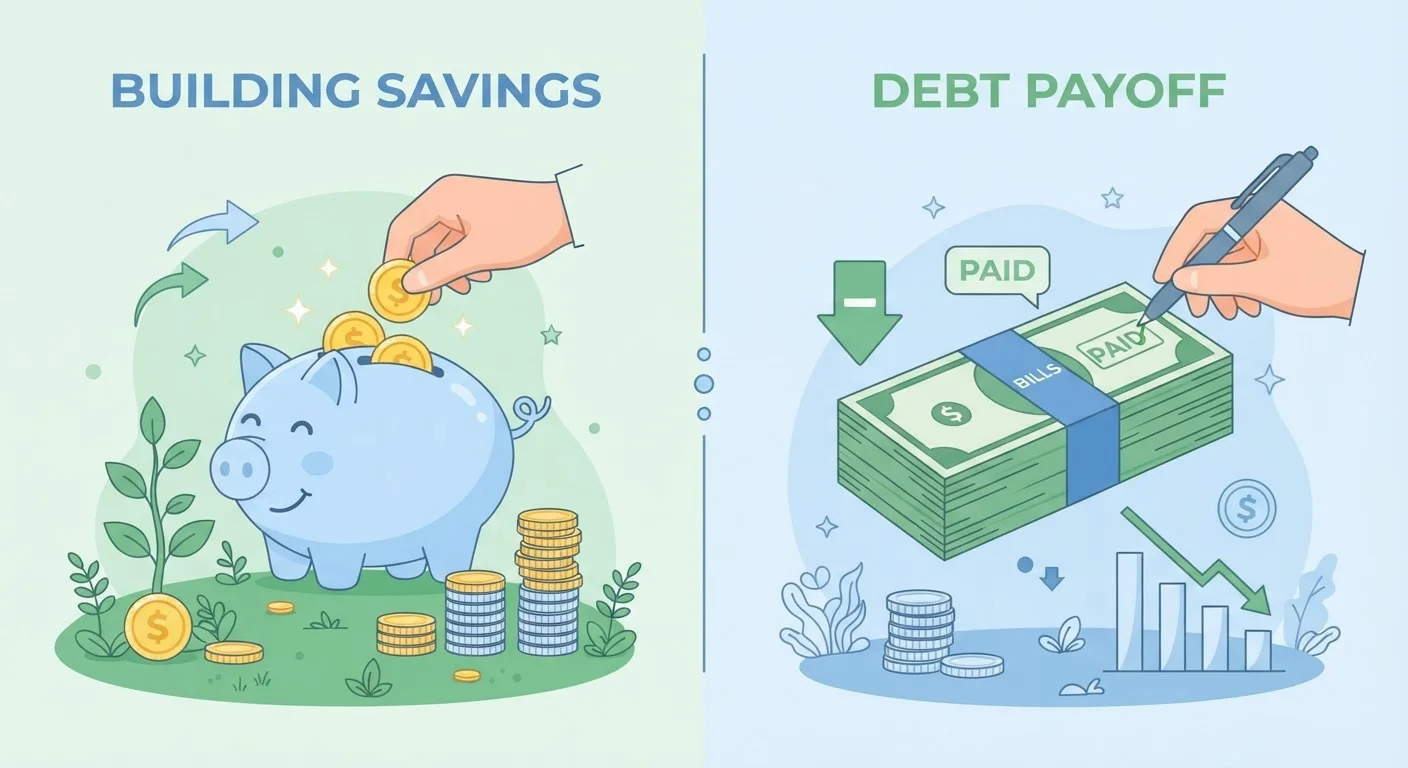
Photo: AnswersVista.com | Trustworthy Information Every Day editorial
Key Takeaways
- High-interest debt-generally above 6-7%-almost always costs more than savings can earn.
- A small emergency fund of $500-$1,000 should exist before aggressively paying down debt.
- Employer 401(k) matches are effectively a 50-100% return, making them worth capturing before extra debt payments.
- Low-interest debt like federal student loans may reasonably be carried while building savings.
- There is no single right answer; your income stability and risk tolerance both matter.
Why This Decision Is Harder Than It Looks
On the surface, the math seems simple: pay off high-interest debt before saving, because debt costs more than savings earn. But in practice, most people are managing multiple financial pressures at once-a car repair bill, a retirement account they're behind on, credit card balances from a tough year, and a savings account that sits nearly empty. The question isn't just mathematical; it's also about stability and risk.
Understanding the core trade-off is the first step. Every dollar held in a typical savings account earns interest. Every dollar sitting on a credit card balance costs interest. When the rate you're paying on debt exceeds the rate you're earning on savings, you lose ground by prioritizing savings. That's the essential logic explained in more detail in our piece on high-interest debt and savings accounts.
20%+
Average U.S. credit card interest rate
According to Federal Reserve data, average credit card interest rates have exceeded 20% in recent reporting periods-well above what most savings accounts offer.
$500-$1,000
Recommended starter emergency fund
Many financial educators recommend this minimum cushion before aggressively paying down debt, to prevent a single expense from forcing borrowers back into debt.
50-100%
Effective return of employer 401(k) match
A dollar-for-dollar or 50-cents-on-the-dollar employer match creates an immediate return that typically outpaces any debt interest rate, making it a top priority.
The Non-Negotiables: Do These First
Before deciding whether debt or savings wins, two baseline steps should happen regardless of which direction your numbers point.
1. Build a Minimal Emergency Fund
Having no savings at all while paying down debt is risky. A single unexpected expense-a medical bill, a car breakdown-can force you back into debt, erasing weeks of progress. Most financial educators recommend keeping at least $500 to $1,000 set aside before accelerating debt payments. This isn't a full emergency fund; it's a buffer that keeps your debt payoff plan from unraveling.
2. Capture Any Employer 401(k) Match
If your employer matches retirement contributions, contribute at least enough to get the full match before making extra debt payments. A 50% or 100% instant return on those dollars outpaces virtually any debt interest rate. Leaving that match on the table is one of the most expensive financial decisions a worker can make.
Start With the Match, Then Tackle Debt
When to Prioritize Debt Payoff
Once your emergency buffer is in place and you're capturing any employer match, the interest rate on your debt becomes the deciding factor.
Prioritize debt payoff when:
- Your debt carries an interest rate above approximately 6-7%
- You're carrying credit card balances (average rates exceed 20% as of recent Federal Reserve data)
- The psychological weight of debt is affecting your decision-making or wellbeing
- Your income is stable enough that you don't urgently need a larger safety net
High-interest debt compounds quickly. A $5,000 credit card balance at 22% costs over $1,100 in interest per year if only minimum payments are made. The hidden costs of carrying debt while saving go beyond interest alone-they include opportunity cost and the drag on your overall financial momentum.
If you're not sure how to structure your payoff plan, our comparison of avalanche vs. snowball methods walks through both approaches.
When Saving Can Take Priority
Not all debt is created equal. If your debt carries a low interest rate-say, 3-5% on federal student loans or a fixed auto loan-the calculus shifts. Money redirected toward savings or invested in a diversified portfolio may potentially earn comparable returns over time, though investment returns are never guaranteed and carry risk.
Consider prioritizing savings when:
- Your debt interest rate is below 5% and fixed
- Your emergency fund is thin relative to your expenses or income stability
- You have a specific near-term goal (home purchase, medical expense) requiring liquid cash
- You have no retirement savings and are approaching mid-career
It's also worth distinguishing between short-term savings needs and long-term investing. Our article on short-term savings vs. long-term investing can help clarify which tool fits which goal.
Making the Decision for Your Situation
There's no formula that works for everyone, but a simple framework helps. Ask yourself three questions:
- Do I have at least $500-$1,000 in an emergency fund? If no, build that first.
- Am I leaving employer retirement match money on the table? If yes, fix that next.
- What interest rate is my debt carrying? Above ~7%, focus on debt. Below ~5%, consider balancing both goals.
From there, your income stability and personal risk tolerance matter. Someone with a variable income or irregular expenses should generally keep a larger emergency fund before attacking debt aggressively. Someone with a stable salary and low overhead may be comfortable accelerating debt payoff with a smaller cushion.
For a structured starting point, the Budgeting Basics hub covers how to map your monthly cash flow-essential groundwork before making this decision. And if you're ready to commit to a debt payoff plan, our step-by-step credit card debt framework offers a structured path forward.
This article is for general informational and educational purposes only and does not constitute personalized financial advice. Consult a qualified financial professional for guidance tailored to your individual circumstances.
Frequently Asked Questions
The content provided on our blog site traverses numerous categories, offering readers valuable and practical information. Readers can use the editorial team’s research and data to gain more insights into their topics of interest. However, they are requested not to treat the articles as conclusive. The website team cannot be held responsible for differences in data or inaccuracies found across other platforms. Please also note that the site might also miss out on various schemes and offers available that the readers may find more beneficial than the ones we cover.