
Corded vs. Cordless Vacuums: What the Specs Actually Mean for Your Home

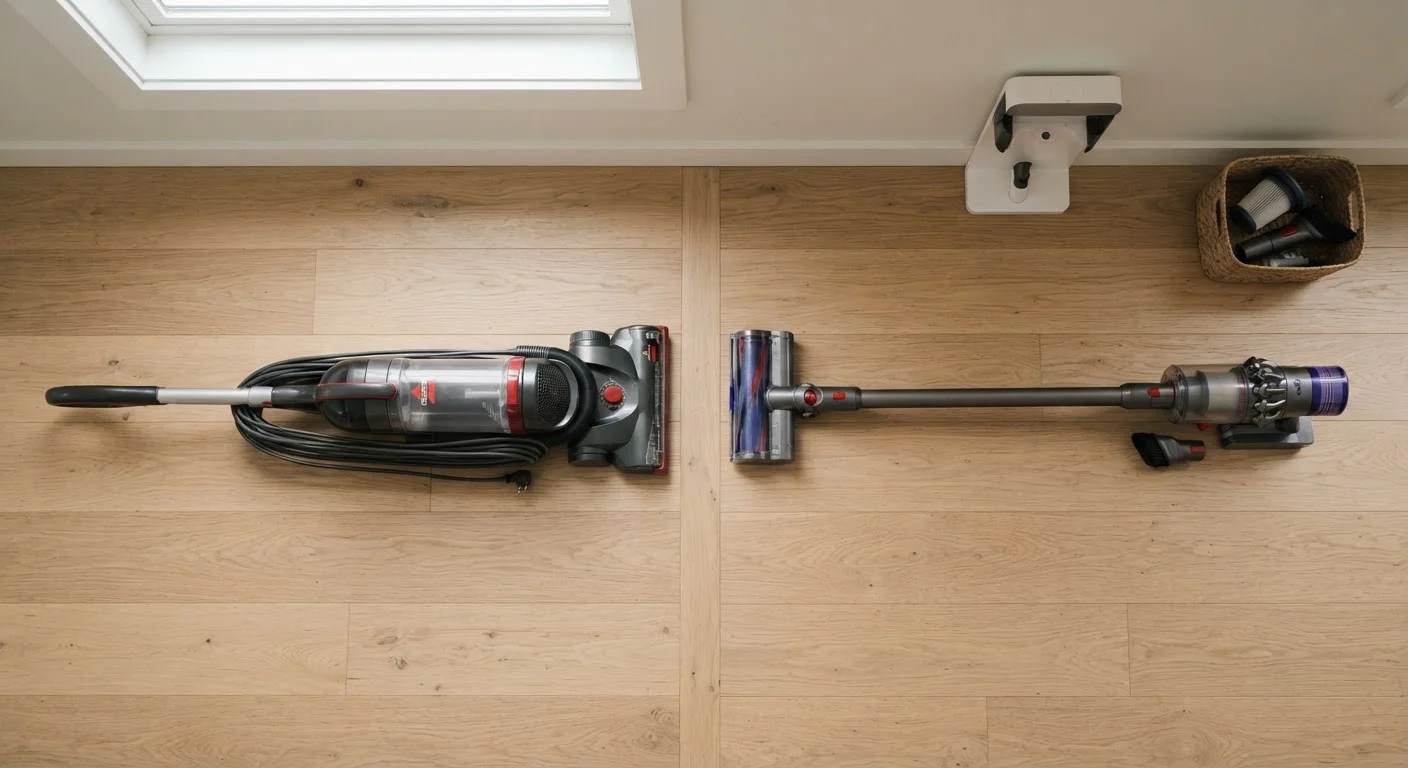
Photo: AnswersVista.com | Trustworthy Information Every Day editorial
Key Takeaways
- Corded vacuums deliver consistent suction because they draw unlimited power from the wall, while cordless motors are constrained by battery capacity.
- Battery runtime on cordless models is typically measured under low-power conditions - real-world run time on full suction is often significantly shorter.
- Airwatts (AW) is a more meaningful suction metric than watts alone, as it accounts for both airflow and sealed suction pressure.
- Weight matters more for cordless vacuums since users carry them continuously rather than rolling or pushing them.
- Filtration quality - particularly HEPA-rated filters - is spec-sheet detail worth scrutinizing regardless of whether the vacuum is corded or cordless.
What Suction Specs Actually Tell You
Manufacturers publish suction figures in several units - watts, pascal (Pa), and airwatts (AW) - and conflating them leads to poor comparisons. Watts measure motor input power, not cleaning effectiveness. Pascal measures sealed suction (how hard the vacuum pulls against a blocked nozzle). Airwatts, calculated from both airflow and suction pressure, come closest to reflecting real cleaning performance at the floor head.
Corded vacuums typically operate between 800 and 1,400 watts of motor input, maintaining that output continuously. Cordless vacuums often advertise comparable wattage in boost mode, but that peak is unsustainable - most battery-powered motors step down to preserve charge within minutes. When comparing suction specs, look for airwatt ratings measured at the floor head, not at the motor, and note whether a cordless model's figure is recorded in boost or standard mode.
For a broader look at how to interpret the numbers manufacturers publish, see Reading Between the Lines of Product Specification Sheets.
| Criterion | Corded Vacuums | Cordless Vacuums |
|---|---|---|
| Suction consistency | Constant throughout session | Diminishes as battery depletes |
| Peak airwatts (typical range) | 180-300 AW | 60-150 AW (boost mode) |
| Runtime limit | Unlimited (plugged in) | 8-60 min depending on mode |
| Weight (typical) | 10-20 lbs. (wheeled) | 4-9 lbs. (handheld) |
| Sealed HEPA filtration | Common in full-size models | Available but less consistent |
| Dust bin/bag capacity | 1-3 liters typical | 0.3-0.8 liters typical |
| Portability (stairs, cars) | Limited by cord length | Unrestricted |
| Long-term maintenance cost | Lower (no battery replacement) | Battery pack replacement needed |
Battery Life: Reading the Runtime Claim Critically
A cordless vacuum advertised as offering "60 minutes of runtime" almost always measures that figure on the lowest suction setting - useful for bare floors but insufficient for carpet or upholstery. On full or boost power, the same unit may deliver 8 to 15 minutes. That's not a defect; it's how battery chemistry works under load. The spec is technically accurate but contextually misleading.
When evaluating runtime, identify the mode in which it was measured, and match it to how you actually clean. If you primarily clean hard floors on low power, a published runtime may be realistic. If you primarily vacuum medium-pile carpet, divide the advertised figure by three to four as a practical estimate.
8-15 min
Typical cordless runtime on full suction
Consumer testing consistently shows cordless vacuums achieve a fraction of advertised runtime when operated at maximum power on carpet.
~20%
Typical battery capacity loss after 300-500 charge cycles
Lithium-ion cell degradation is a well-documented characteristic affecting most cordless power tools and vacuum batteries over time.
0.3 microns
Particle size captured by certified HEPA filters
HEPA is a standardized filtration grade requiring 99.97% capture efficiency at 0.3 microns - but only a sealed system prevents bypass leakage.
Battery degradation is another factor spec sheets rarely address. Lithium-ion cells lose capacity with charge cycles - generally around 20% capacity loss after 300 to 500 full cycles, depending on cell quality and thermal management. A removable, replaceable battery pack extends a cordless vacuum's useful life significantly. This detail doesn't appear prominently in specs but matters for long-term value.
Weight, Filtration, and the Specs Often Overlooked
Weight affects usability differently depending on vacuum type. A corded upright sits on wheels and is pushed rather than carried, so a few extra pounds rarely matter. A cordless stick vacuum is held aloft during use, meaning every ounce compounds fatigue - particularly on ceilings, stairs, or extended sessions. Models advertised at 5 lbs. versus 7 lbs. may feel dramatically different after 20 minutes of continuous use.
Filtration specs deserve more attention than they typically receive. A HEPA filter, by standardized definition, captures 99.97% of particles at 0.3 microns. However, a vacuum can contain a HEPA filter while still leaking unfiltered air around gaskets and seals. The meaningful spec is "sealed HEPA system," indicating the entire airpath is filtered. Corded full-size models more frequently offer sealed systems; cordless models vary widely.
Bin or bag capacity is also relevant but often underweighted. Smaller bins on cordless models fill faster, requiring mid-session emptying - which partially offsets the convenience advantage. A 0.5-liter bin may be adequate for a studio apartment; it will frustrate users cleaning a 2,000-square-foot home.
When two models look nearly equivalent on paper, the methodology in How to Compare Two Similar Products When the Specs Look Nearly Identical gives you a structured path to finding meaningful differences. And if you're weighing whether an automated option makes more sense for your routine, Robot Vacuums vs. Traditional Vacuums offers a useful side-by-side on that front.
Specs Are Measured in Labs, Not Living Rooms
The content provided on our blog site traverses numerous categories, offering readers valuable and practical information. Readers can use the editorial team’s research and data to gain more insights into their topics of interest. However, they are requested not to treat the articles as conclusive. The website team cannot be held responsible for differences in data or inaccuracies found across other platforms. Please also note that the site might also miss out on various schemes and offers available that the readers may find more beneficial than the ones we cover.