
Memory Foam, Innerspring, and Hybrid Mattresses: A Framework for Comparing Them

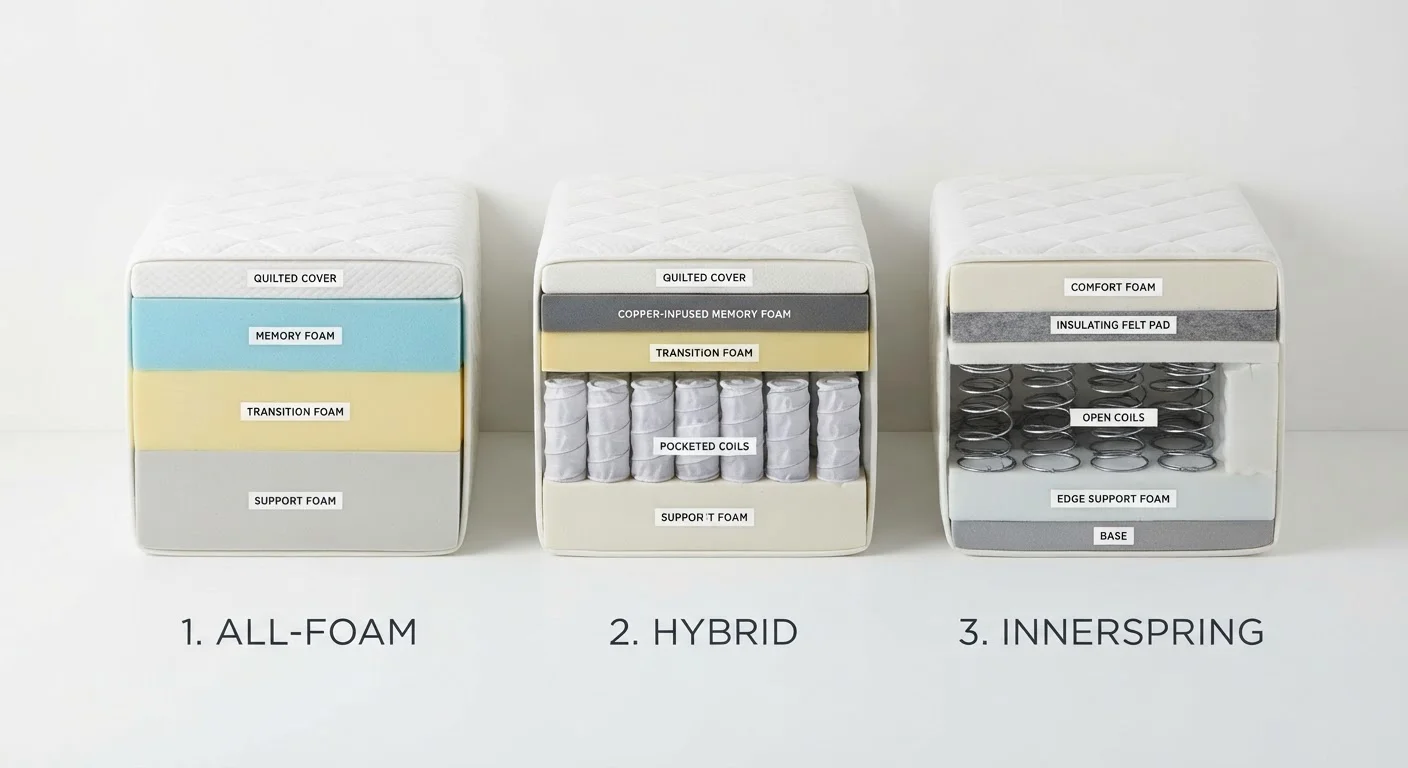
Photo: AnswersVista.com | Trustworthy Information Every Day editorial
Key Takeaways
- Memory foam excels at pressure relief and motion isolation but can trap heat.
- Innerspring mattresses offer strong airflow and responsive bounce but less contouring support.
- Hybrids combine foam comfort layers with coil support cores, balancing multiple needs.
- Your sleep position and body weight are the most reliable filters for narrowing down mattress type.
- Price differences between types reflect materials and manufacturing, not inherently better sleep quality.
Why Mattress Type Is the Right Starting Point
Mattress marketing leans heavily on proprietary terms - "adaptive foam," "pocketed coil technology," "zoned support" - that can make comparison feel impossible. But beneath the branding, virtually every consumer mattress falls into one of three structural categories: memory foam, innerspring, or hybrid. Understanding how each is built gives you a neutral framework that cuts through the noise.
This matters because mattress type determines the baseline trade-offs you're working with. Firmness, feel, and even specific features like cooling can be tuned within a category, but the fundamental construction shapes what's possible. For a broader look at how to approach any major purchase with clarity, see The Smart Shopper's Complete Framework for Evaluating Any Product.
Memory Foam: What It Does Well and Where It Falls Short
Memory foam mattresses are built entirely from polyurethane-based foam layers. The defining characteristic is viscoelasticity - the material softens with body heat and pressure, contouring closely around shoulders, hips, and the lumbar region. This makes it particularly effective at redistributing pressure for side sleepers and people with joint sensitivity.
Motion isolation is another practical strength. Because foam absorbs movement rather than transferring it, a partner shifting positions is less disruptive. The trade-off is heat retention: dense foam restricts airflow, and sleepers who run warm often find all-foam mattresses uncomfortable. Manufacturers address this with gel infusions and perforated layers, but results vary and should be verified through owner reviews rather than spec claims alone.
Memory foam also has a slower response time - when you reposition, the surface takes a moment to adjust. This "stuck in the mattress" sensation bothers some sleepers, particularly those who switch positions frequently during the night.
Check Foam Density Before You Buy
Innerspring: The Case for Traditional Coil Construction
Innerspring mattresses use a network of steel coils as their primary support system, typically topped with a thin comfort layer of foam or fiber. The coil design creates substantial airflow through the mattress core, making innerspring the cooler-sleeping option for most people by default - without relying on special treatments.
The bounce and responsiveness of coils suit stomach and back sleepers who need a firmer, more supportive surface that doesn't allow significant sinkage. Ease of movement on the surface is another practical advantage for combination sleepers.
The main limitations are pressure point relief and motion isolation. Coils don't contour the way foam does, so side sleepers may feel more pressure at the shoulder and hip. And coil movement can transfer more readily across the mattress, which matters in shared sleep environments. Coil count and gauge (wire thickness) both affect durability and feel - higher gauge numbers mean thinner, softer wire, while lower gauges indicate thicker, firmer coils.
| Memory Foam | Innerspring | Hybrid | |
|---|---|---|---|
| Pressure Relief | Excellent - deep contouring | Limited - minimal contouring | Good - depends on foam layer thickness |
| Motion Isolation | Excellent - absorbs movement | Poor to fair - coils transfer motion | Good - pocketed coils reduce transfer |
| Temperature Regulation | Poor by default - traps heat | Excellent - open airflow through coils | Good - coils aid airflow under foam |
| Surface Responsiveness | Slow - gradual contouring | Fast - immediate bounce | Moderate - foam slows coil bounce |
| Edge Support | Weak - foam compresses at edges | Strong - perimeter coils reinforce edges | Strong - coil core supports edges |
| Typical Durability | 7-10 years (density-dependent) | 7-10 years (gauge-dependent) | 8-10 years (material quality-dependent) |
| Relative Price Point | Low to mid-range | Low to mid-range | Mid to high range |
Hybrid Mattresses: Balancing the Trade-Offs
Hybrids layer several inches of foam - often memory foam or latex - over a pocketed coil support core. The goal is to capture the pressure-relieving contour of foam while retaining the airflow, bounce, and edge support that coils provide. This makes hybrids the most versatile category on paper.
In practice, how well a hybrid executes that balance depends heavily on the thickness and quality of each layer. A thin foam comfort layer over coils behaves more like a firm innerspring. A thick, dense foam layer over coils narrows the gap with an all-foam mattress. The coil system beneath also matters: pocketed coils (individually wrapped) reduce motion transfer more than interconnected Bonnell coils.
The trade-off is price. Combining two distinct material systems raises manufacturing cost, and hybrids typically sit at a higher price point than comparable innerspring or all-foam options. Whether that premium is justified depends on whether your sleep needs actually require both properties - not everyone does. If you're concerned about letting marketing inflate the comparison, watch for common comparison pitfalls before you finalize a decision.
How to Use Sleep Position and Body Weight as Filters
Mattress type becomes much easier to evaluate when you apply two concrete personal filters: sleep position and body weight. These factors determine how much sinkage and surface contouring you actually need.
- Side sleepers put concentrated pressure on shoulders and hips. More surface contouring - memory foam or a thick hybrid comfort layer - generally reduces that pressure.
- Back sleepers need lumbar support without excessive sinkage. Medium-firm innerspring or hybrid options typically work well.
- Stomach sleepers are at risk of spinal misalignment if the midsection sinks too deeply. A firmer surface - innerspring or a firm hybrid - is usually preferable. Consult a healthcare professional if you have existing back issues before relying on this guidance alone.
- Higher body weight compresses foam layers more quickly, which can affect both support and longevity. Thicker coil gauges and denser foam densities are worth prioritizing in this case.
These filters narrow the field before you get into brand-specific features. For more on how your broader sleep environment interacts with your mattress choice, see Sleep Hygiene: The Habits That Shape How Well You Rest.
The content provided on our blog site traverses numerous categories, offering readers valuable and practical information. Readers can use the editorial team’s research and data to gain more insights into their topics of interest. However, they are requested not to treat the articles as conclusive. The website team cannot be held responsible for differences in data or inaccuracies found across other platforms. Please also note that the site might also miss out on various schemes and offers available that the readers may find more beneficial than the ones we cover.