
Hidden Storage Solutions That Make the Most of Dead Space

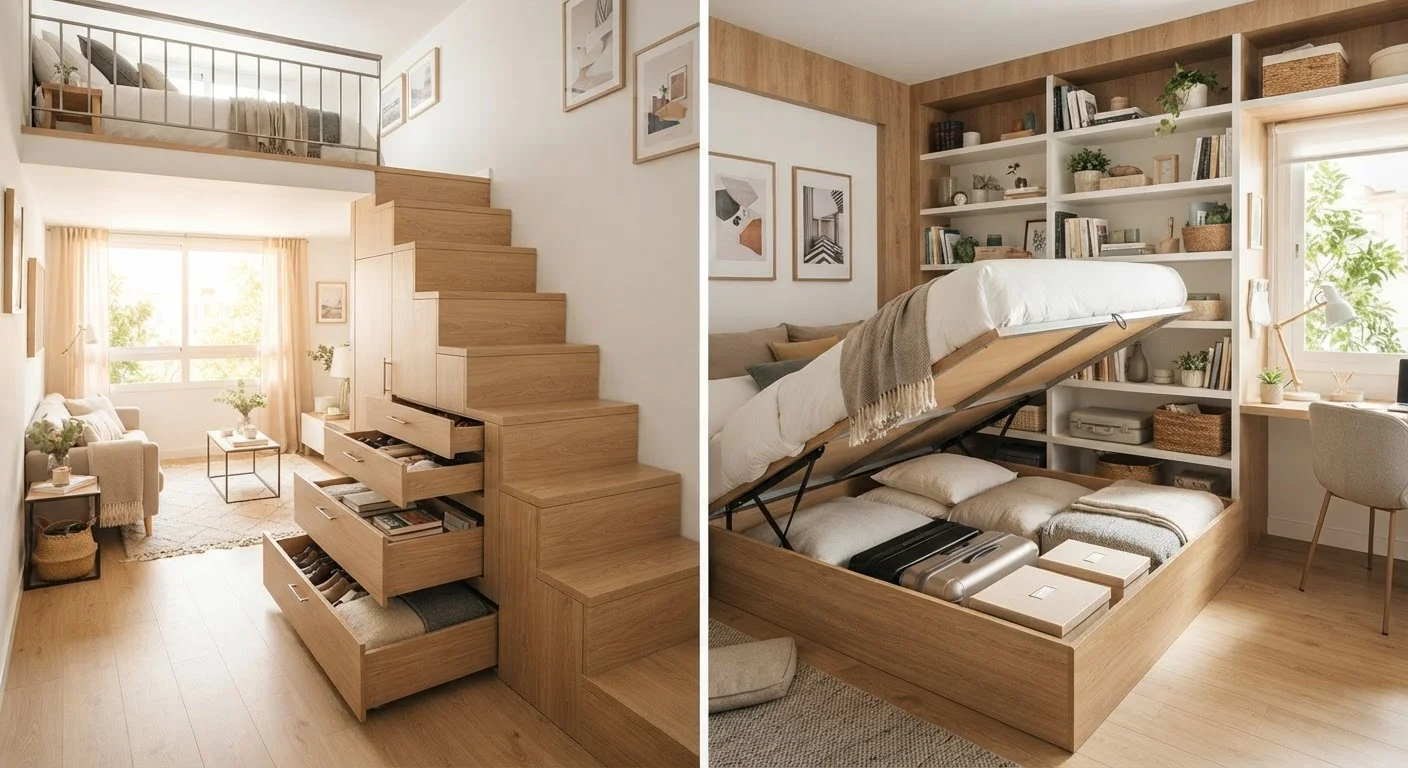
Photo: AnswersVista.com | Trustworthy Information Every Day editorial
Key Takeaways
- Most homes have significant unused storage capacity hidden in plain sight.
- Stair risers, bed frames, and toe kicks are among the most overlooked storage opportunities.
- Hidden storage reduces visual clutter without sacrificing accessibility or function.
- Many dead-space solutions require minimal construction and no permits.
- Strategic storage placement can make small rooms feel significantly larger.
The Storage You Already Have
Every home contains hidden volume that goes unnoticed - not because it doesn't exist, but because it doesn't look like storage. Stair risers, toe kicks, hollow walls, and the space under your bed all represent functional square footage that most households leave completely empty. The difference between a home that feels cluttered and one that feels spacious often isn't square footage - it's how well the existing volume is used.
Unlike open shelving - which trades clutter for visibility (a trade-off worth understanding, as explored in our piece on open shelving appeal versus upkeep) - hidden storage keeps items accessible while eliminating visual noise entirely. The seven solutions below cover the most productive dead spaces in a typical American home, from low-effort retrofits to more involved built-ins.
When to Call a Professional
Seven Dead Spaces Worth Claiming
Measure Before You Commit
Stair Risers
The hollow space inside a staircase is one of the most underutilized volumes in any two-story home. Converting the risers - the vertical face of each step - into individual pull-out drawers gives you a natural, low-profile storage system that's built right into your floor plan. Each drawer can hold shoes, seasonal accessories, board games, or anything you'd otherwise cram into a closet.
This modification typically involves a carpenter routing out each riser and fitting it with a drawer box and pull hardware. It's not a DIY project for most homeowners, but the result is permanent, polished, and invisible when the drawers are closed. For a lighter approach, stair risers can also be left as open cubbies with a decorative trim finish.
Each stair riser hides a drawer's worth of storage - right where you already walk every day.
Under-Bed Space
The area beneath a bed frame represents several cubic feet of prime real estate - roughly the volume of a small closet. Bed frames with built-in drawers are widely available in standard mattress sizes, but even a standard frame can be upgraded. Low-profile rolling bins or flat storage containers slide easily beneath most beds and can hold off-season clothing, extra bedding, or shoes with minimal footprint.
For platform beds, consider frames with lift-up bases that use gas pistons to elevate the mattress, revealing a large, flat compartment underneath - ideal for bulkier items like luggage or extra pillows. The key is to use appropriate containers: lidded bins prevent dust accumulation and keep contents organized.
Beneath a standard queen bed lies enough room to store an entire season's wardrobe.
Cabinet Toe Kicks
The recessed base panel at the bottom of kitchen cabinets - called the toe kick - is typically four inches tall and runs the full length of your cabinetry. That space is almost always empty. Shallow pull-out drawers designed specifically for toe kicks can be fitted to hold flat items: baking sheets, serving trays, tablecloths, and cutting boards that are awkward to store vertically.
These drawers sit flush with the toe kick panel and are accessed by pulling a magnetic or finger-grip latch at floor level. Installation requires removing the existing toe kick board and fitting a track system - a task that falls within reach of a confident DIYer or a kitchen installer. For more kitchen-specific strategies, see our guide on organizing a small kitchen without losing counter space.
Toe kick drawers are the kitchen's best-kept secret - wide, shallow, and completely hidden.
Inside Hollow Walls
Walls in wood-frame homes have cavities between studs - typically 3.5 inches deep - that can be converted into recessed shelving or medicine-cabinet-style niches. These in-wall niches are especially useful in bathrooms and hallways, where space is tight but wall real estate is plentiful.
A recessed bathroom niche between studs can hold toiletries, towels, or first aid supplies without protruding into the room at all. In hallways, shallow recessed shelving can store books, keys, or display items. Note that any wall work must avoid electrical, plumbing, or structural elements - always check inside the wall cavity before cutting, and consult a licensed contractor for load-bearing walls. Local building codes may require permits for structural modifications.
A recessed wall niche adds practical storage depth without claiming a single inch of floor space.
Above Cabinet Space
The gap between the tops of upper kitchen or bathroom cabinets and the ceiling is often filled with decorative baskets - but it can do real work. Installing a shallow ledge or fitting labeled bins in this zone creates long-term storage for rarely used items: extra appliances, entertaining serveware, or seasonal décor. Because it's out of everyday sight lines, the visual clutter effect is minimal.
For items stored high, use consistent containers with clear labels facing outward. A sturdy step stool makes retrieval straightforward. This approach pairs naturally with thinking about how you use vertical versus horizontal storage across different rooms.
Above-cabinet space turns an aesthetic gap into a high-capacity storage zone for rarely used items.
Under Staircase Alcoves
The triangular void beneath a staircase - especially in open floor plans - often becomes a catch-all corner. Treated intentionally, it can become a home office nook, a mudroom cubby system, or a floor-to-ceiling shelving unit fitted to the sloped ceiling line. Custom-built storage that follows the angled profile of the underside maximizes every inch.
Even without custom carpentry, the space can be fitted with rolling bins organized by category, hooks mounted to the back wall for bags and coats, and a tension rod for hanging items. For a broader look at tackling storage room by room, the room-by-room home organization checklist is a useful companion resource.
The under-stair alcove, treated as a room within a room, can replace an entire closet.
Door Interiors
The back of most interior doors is an untouched vertical surface. Over-the-door organizers - with pockets, hooks, or racks - mount without hardware and can hold a surprising range of items: pantry goods, cleaning supplies, shoes, jewelry, or office materials. In small bathrooms, a door-mounted rack can replace a full cabinet.
For a more permanent solution, shallow shelving can be surface-mounted directly to the door itself using appropriate hardware sized to the door's core. These shelves work best for lightweight items and should be balanced to avoid straining door hinges. Checking the swing clearance before installation prevents the shelf from catching on surrounding trim or furniture.
The back of a door is a full vertical surface - among the most overlooked in any room.
Putting It All Together
You don't need to tackle every dead space at once. The most effective approach is to identify the two or three areas where clutter consistently accumulates - that's usually where functional storage is missing - and address those first. Toe kick drawers in the kitchen, under-bed bins in the bedroom, and a door-mounted organizer in the bathroom can collectively add meaningful capacity without a single square foot of renovation.
For a structured approach to auditing every room in your home, the room-by-room home organization checklist walks through each space methodically. And if your garage is the real trouble spot, the garage organization guide covers that space in depth. Hidden storage works best when it fits the way you actually live - so start with the space that frustrates you most, and build from there.
The content provided on our blog site traverses numerous categories, offering readers valuable and practical information. Readers can use the editorial team’s research and data to gain more insights into their topics of interest. However, they are requested not to treat the articles as conclusive. The website team cannot be held responsible for differences in data or inaccuracies found across other platforms. Please also note that the site might also miss out on various schemes and offers available that the readers may find more beneficial than the ones we cover.