
Teaching a Dog to Walk Calmly on a Leash

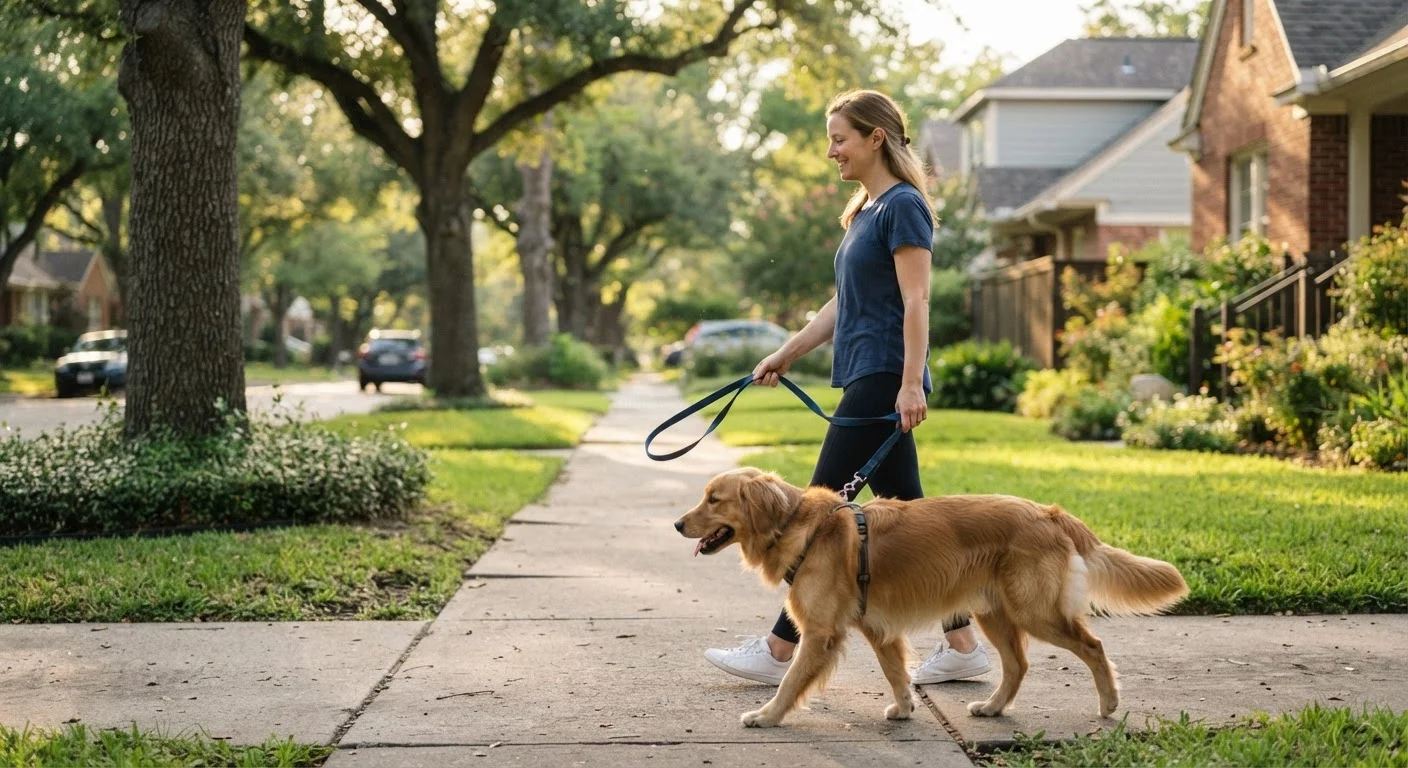
Photo: AnswersVista.com | Trustworthy Information Every Day editorial
Key Takeaways
- Pulling is self-reinforcing - movement is the reward, so stopping it immediately is the first priority.
- Loose-leash walking is built in short, consistent sessions rather than single long attempts.
- Rewarding the correct position teaches dogs what to do, not only what to avoid.
- Inconsistency between sessions - allowing pulling sometimes - resets progress.
- Most dogs show clear improvement within two to three weeks of daily practice.
Why Dogs Pull - and Why It's So Hard to Stop
Dogs pull on the leash for a straightforward reason: it works. When a dog lunges toward a smell or another dog and the owner follows, the dog reaches its goal. That outcome is reinforcing, which means the behavior becomes more likely next time. Pulling is not dominance, stubbornness, or spite - it is a learned behavior maintained by its consequences.
Understanding this is the foundation of effective training. If you want to separate myth from evidence in dog training generally, current behavioral science consistently points to the same conclusion: reward what you want, remove the reward for what you don't. For loose-leash walking, that means forward movement is the reward - and it must stop the instant the leash tightens.
If you are starting fresh with a new dog, the day-one training guide covers the foundational principles that make this and every other skill easier to teach.
What you will need
What You'll Need Before You Start
Gather the right equipment before your first session. The tools below are not optional add-ons - they directly affect how quickly the dog learns the connection between the correct position and the reward.
Front-clip harness
Redirects forward pulling pressure to the side, making it physically easier to guide the dog back to position without discomfort.
Standard 4-6 foot leash
Provides the handler a consistent point of contact; retractable leashes train dogs to expect variable tension and undermine loose-leash work.
Training treats (small, high-value)
Used to mark and reward the correct walking position in real time during every practice session.
Clicker or verbal marker
A precise, consistent signal that tells the dog exactly which behavior earned the reward.
Treat pouch
Keeps rewards accessible at hip level so you can deliver them quickly without fumbling.
Step-by-Step: Building a Loose Leash Walk
Follow the steps below in order. Resist the urge to move to busier environments before the dog is consistent in quiet ones - environmental difficulty is the single most common reason training stalls.
Choose the right equipment
Start with a standard 4-6 foot leash attached to a flat collar or front-clip harness. Avoid retractable leashes entirely during training - they teach the dog that tension equals freedom to move. A front-clip harness is particularly useful for strong pullers because it turns the dog's body rather than adding neck pressure when the leash goes taut.
Establish a marker and load your treats
Before going outside, decide on your marker - either a clicker or a short, consistent verbal cue like "yes." Load your treat pouch with small, soft rewards your dog finds highly motivating. The marker bridges the gap between the moment the dog does the right thing and the moment it receives the treat, so timing accuracy matters more than the specific marker you choose.
Start in a low-distraction environment
Begin every new training phase in the quietest space available - a backyard, empty parking lot, or a calm hallway. Distractions compete with you for your dog's attention, and in the early stages you need the dog focused on you. As performance becomes reliable in low-distraction settings, gradually introduce more challenging environments.
Teach the heel position with stationary rewards
Stand still and lure your dog to your left side (or your preferred side - consistency matters more than which side you choose). The dog's shoulder should be roughly aligned with your leg. Mark and treat several times in this position without moving. You are teaching the dog that standing next to you is a very good place to be.
Introduce movement using the stop-and-reward method
Take two or three steps, then stop and mark-and-treat if the leash remained loose. Gradually extend the number of steps between rewards as the dog succeeds. The key principle: movement stops the instant the leash goes taut. Turn and walk in the opposite direction, or simply stop and wait. The dog learns that pulling ends forward progress, while a loose leash keeps it moving.
Proof the behavior in gradually busier environments
Once your dog maintains a loose leash reliably in quiet areas, begin adding mild distractions - a neighbor's yard, a quiet street, then a park perimeter. Drop back to more frequent rewards whenever you raise the difficulty level. If your dog is struggling with triggers like other dogs or cyclists, see our guide on managing reactive dogs for targeted strategies.
Maintain consistency across all handlers and all walks
Every person who walks the dog must follow the same rules. If one family member allows pulling while another enforces a loose leash, the dog learns that pulling sometimes works - which is enough to keep the behavior alive. Brief everyone in the household on the stop-and-redirect method before handing over the leash.
Never Use Aversive Equipment Here
Troubleshooting Common Problems
Even with a clear method, a few challenges come up regularly:
- Dog ignores treats outdoors: The environment is too distracting. Drop back to a quieter location and use higher-value rewards - try real meat or cheese instead of dry biscuits. Our article on why dogs ignore commands covers the most common attention breakdowns in detail.
- Dog does well on quiet streets but falls apart in busy areas: This is normal. Distraction proofing is a gradual process. Treat every new environment as a restart at an easier difficulty level.
- Progress feels inconsistent day to day: Dogs learn in variable steps, not a straight line. A bad session after a good one does not erase progress - keep the sessions short and positive.
Sniff Breaks Are Part of the Walk
Loose-leash walking takes patience, but it is one of the highest-return skills you can teach. A dog that walks calmly beside you is safer, easier to manage in public, and - according to many trainers - a more relaxed companion overall because the walk itself becomes a predictable, low-stress routine.
The content provided on our blog site traverses numerous categories, offering readers valuable and practical information. Readers can use the editorial team’s research and data to gain more insights into their topics of interest. However, they are requested not to treat the articles as conclusive. The website team cannot be held responsible for differences in data or inaccuracies found across other platforms. Please also note that the site might also miss out on various schemes and offers available that the readers may find more beneficial than the ones we cover.