
The Real Differences Between Air Fryers and Convection Ovens

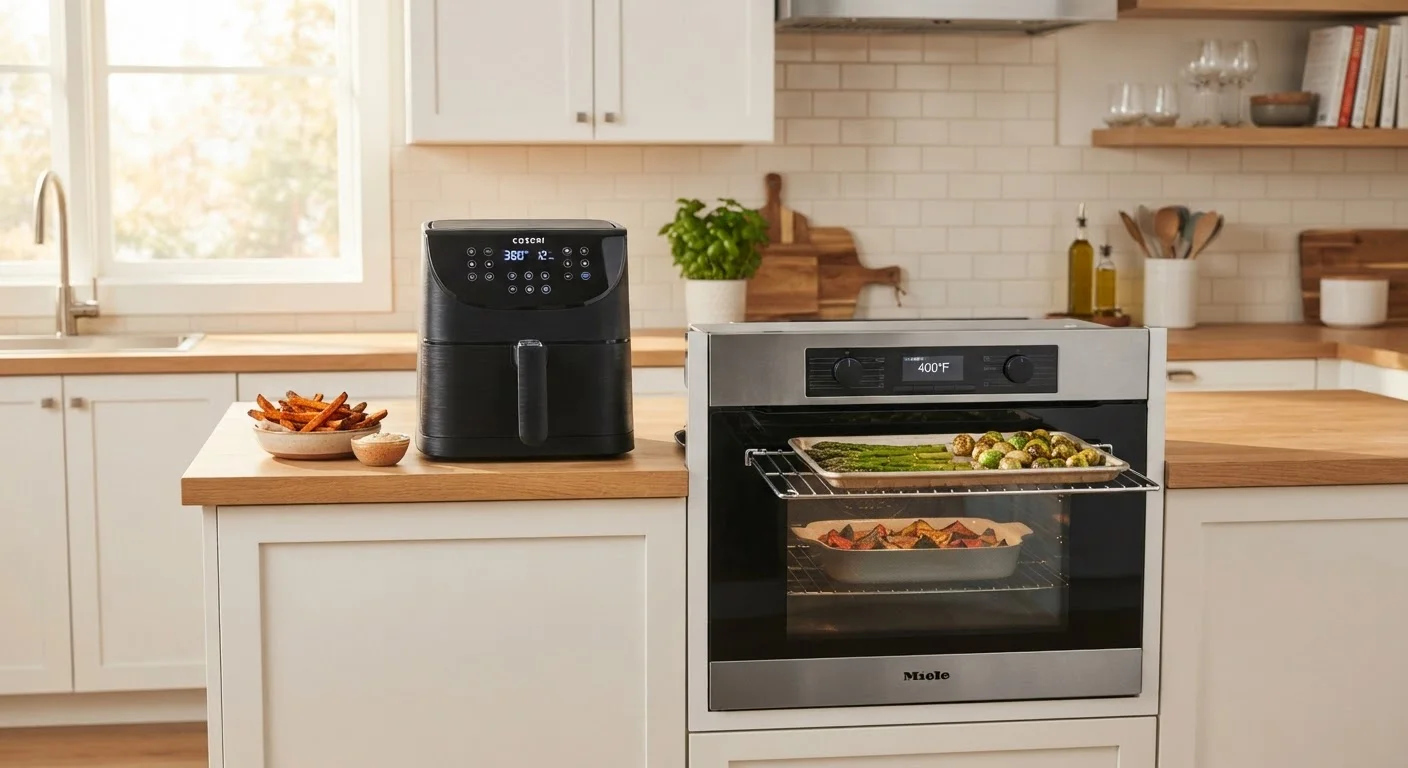
Photo: AnswersVista.com | Trustworthy Information Every Day editorial
Key Takeaways
- Both appliances circulate hot air, but air fryers do so at much higher intensity in a smaller chamber.
- Air fryers preheat in 2-3 minutes; convection ovens typically need 10-15 minutes.
- Convection ovens handle larger quantities and a broader range of cooking tasks.
- Air fryers excel at producing crispy textures quickly but have limited cooking capacity.
- Your cooking habits and kitchen space are the most important factors in choosing between them.
The Shared Mechanism - and Where It Diverges
Air fryers and convection ovens share one fundamental technology: a fan that circulates hot air around food to cook it faster and more evenly than traditional radiant heat. That's a meaningful similarity, but it's also where the comparison largely ends.
In a convection oven, a fan (usually positioned at the rear) distributes heat produced by electric or gas elements across a spacious interior - often 4 to 6 cubic feet. The result is reliable, even cooking across multiple racks. For context on how heat sources affect cooking outcomes, see our breakdown of gas vs. electric range tradeoffs.
Air fryers work on the same convection principle but compress it into a much smaller chamber - typically 2 to 6 quarts. A more powerful fan relative to the cooking volume pushes hot air at higher velocity, creating an effect closer to deep frying than standard oven cooking. The intense airflow strips surface moisture from food quickly, producing the crispy exterior that's the appliance's defining selling point.
| Criterion | Air Fryer | Convection Oven |
|---|---|---|
| Cooking capacity | 2-6 quarts (1-2 servings) | 4-6+ cubic feet (multiple servings) |
| Preheat time | 2-3 minutes | 10-15 minutes |
| Airflow intensity | Very high (compact chamber) | Moderate (large chamber) |
| Best texture output | Crispy, dry exteriors | Even browning, delicate baking |
| Energy per small meal | Lower | Higher |
| Counter/install footprint | Small, portable | Large or built-in |
| Multi-rack cooking | No | Yes |
| Price range (general) | Lower to mid | Mid to high |
Practical Differences That Actually Matter
Preheating time: Air fryers reach cooking temperature in roughly 2-3 minutes. Most convection ovens need 10-15 minutes to fully preheat, which adds up meaningfully on busy weeknights.
Capacity: A standard countertop air fryer basket holds enough food for one or two servings comfortably - a single-layer of chicken wings, a small batch of fries, or a couple of fish fillets. Overfilling the basket defeats the airflow and undermines crispiness. Convection ovens accommodate sheet pans, multiple racks, whole roasts, or a full batch of cookies without compromising results.
Texture output: For items where a crackling, dry exterior is the goal - frozen snacks, chicken thighs, roasted vegetables - air fryers consistently outperform. For baked goods requiring gentle, uniform heat, such as cakes or delicate pastries, convection ovens are the more reliable tool.
Energy use: Because an air fryer heats a smaller space for a shorter time, it typically consumes less electricity per cooking session when preparing small portions. Running a full-size convection oven for a tray of leftovers is comparatively inefficient.
2-3 min
Typical air fryer preheat time
Compared to 10-15 minutes for most full-size convection ovens, the time savings add up significantly over frequent use.
~6 qt
Maximum common air fryer basket size
Even the largest consumer air fryer baskets hold considerably less food than a standard oven rack, limiting batch cooking.
1,200-1,800W
Typical air fryer wattage range
Most full-size convection ovens draw 2,000-5,000 watts, making air fryers more energy-efficient for small-portion cooking.
Which One Belongs in Your Kitchen?
The answer depends on three honest questions: How many people do you typically cook for? How much counter or cabinet space can you dedicate? And what types of meals do you make most often?
For singles, couples, or anyone reheating leftovers and cooking quick proteins, an air fryer delivers speed and texture that a convection oven simply can't match at that scale. For households cooking full dinners, batch-prepping meals, or baking regularly, the convection oven's capacity and versatility justify its footprint - whether it's a built-in wall oven or a large countertop model.
Some households find genuine value in owning both: the air fryer handles weekday quick-cook tasks, while the convection oven takes on larger weekend meals. If budget or space forces a single choice, define your most common cooking scenario first, then match the appliance to that reality rather than to the one that sounds more impressive.
The core principle here mirrors decisions in other comparison contexts - matching the right tool to the actual job. Much like choosing between synthetic and conventional motor oil, the right answer depends on your specific conditions, not a universal ranking.
The content provided on our blog site traverses numerous categories, offering readers valuable and practical information. Readers can use the editorial team’s research and data to gain more insights into their topics of interest. However, they are requested not to treat the articles as conclusive. The website team cannot be held responsible for differences in data or inaccuracies found across other platforms. Please also note that the site might also miss out on various schemes and offers available that the readers may find more beneficial than the ones we cover.