
The Psychology Behind Sale Prices - and How to Shop Around It

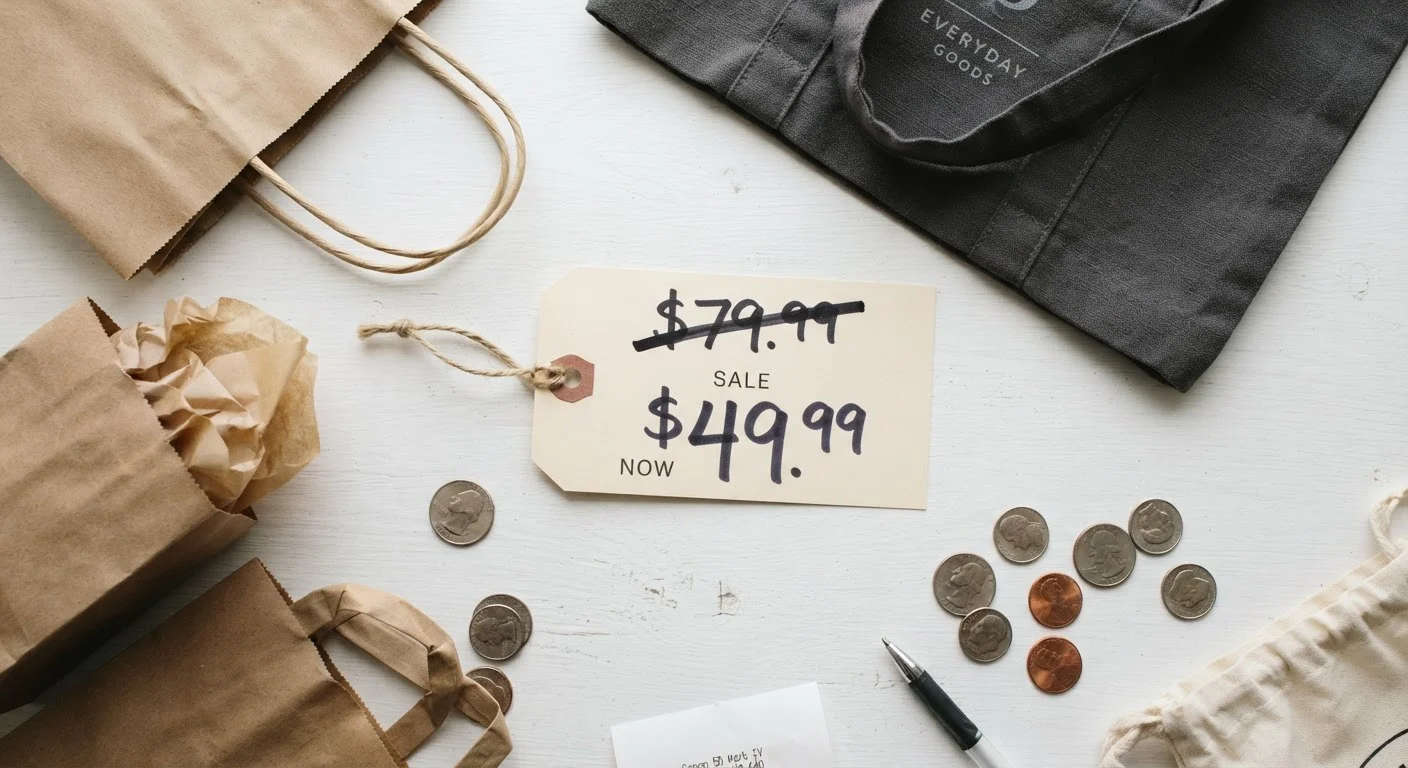
Photo: AnswersVista.com | Trustworthy Information Every Day editorial
Key Takeaways
- A crossed-out 'original' price is a reference point, not a neutral fact - its accuracy varies widely by retailer.
- Urgency cues like countdown timers are designed to suppress careful deliberation, not inform it.
- Percentage discounts feel larger than dollar amounts at lower price points, even when the math is identical.
- Knowing the realistic price range for a product category is more useful than reacting to any single sale label.
- A lower price tag doesn't automatically mean better value if quality or fit falls short of your actual needs.
Why Retailers Design Prices to Be Felt, Not Just Read
Pricing is rarely a neutral communication of value. Retailers invest heavily in how prices are displayed, sequenced, and framed because decades of consumer research confirm that presentation shapes spending decisions at least as much as the numbers themselves.
The core mechanism is anchoring. When you see a product listed at $120, crossed out, with $79 beside it, your brain does not evaluate $79 on its own terms. It evaluates $79 relative to $120 - a reference point the retailer set deliberately. That anchor doesn't need to reflect a price anyone actually paid; it just needs to be visible first.
Layered on top of anchoring is loss aversion - the well-documented tendency for people to feel the pain of a loss more acutely than the pleasure of an equivalent gain. Framing a sale as "savings you'd lose by waiting" exploits this asymmetry. Countdown timers, dwindling stock indicators, and flash-sale labels all serve the same function: convert deliberation into urgency.
Sale Framing Is Legal - and Ubiquitous
For a closer look at how specific display techniques like decoy pricing and reference prices shape perception, see our article on retail pricing illusions that influence spending.
The Tactics Most Shoppers Don't Recognize in the Moment
Percentage framing is one of the most effective and underappreciated tools. '50% off' and '$15 off a $30 item' are mathematically identical, but percentage framing feels more significant - especially on smaller purchases. Retailers tend to use percentage labels when the relative figure is high, and dollar figures when the absolute saving sounds more impressive. Neither is inherently honest or dishonest; both are chosen to maximize perceived impact.
Charm pricing - ending prices in .99 or .95 - continues to influence purchasing because the leftmost digit dominates quick mental processing. A price of $49.99 is processed as being closer to $40 than to $50 in fast, automatic thinking, even though the gap is one cent.
Bundling and threshold promotions ("spend $50, get free shipping") can push shoppers to add items they don't need in order to reach an arbitrary threshold, often spending more than they would have on shipping alone.
~40%
Consumers who check price history before buying
Survey data from consumer research organizations suggests a substantial minority of shoppers use price-tracking tools, though the majority still rely on in-store or on-page framing alone.
1¢
Difference between charm-priced and round-number items
Behavioral economics literature consistently finds that prices ending in .99 or .95 are perceived as significantly lower than the nearest round number, despite a trivial numerical gap.
2-3x
Loss aversion weight versus equivalent gain
Research originating from Kahneman and Tversky's prospect theory indicates that losses feel roughly two to three times more impactful than gains of the same magnitude.
Understanding these mechanics doesn't require rejecting sales entirely - it requires evaluating them on your terms rather than the retailer's framing.
How to Evaluate a Sale Price on Your Own Terms
The most useful shift is moving from relative thinking ("this is cheaper than the original price") to absolute thinking ("is this a fair price for this item right now, given my needs?"). A few practical anchors help:
- Know the realistic price range. Before a purchase, spend a few minutes checking what the item sells for across multiple retailers. This gives you an independent reference point, not one the seller chose for you.
- Check price history. Publicly available browser tools and shopping extensions can show how a product's price has moved over weeks or months. A "40% off" label loses impact when the price has been at that level for most of the year.
- Separate the deal from the decision. Ask whether you would buy this item at this price if there were no sale banner - just the price. If the answer is yes, it may be a genuine opportunity. If you're mainly motivated by the discount itself, pause.
For purchases where timing genuinely matters, certain product categories follow predictable seasonal markdown cycles tied to inventory rotation and model changeovers. Understanding those rhythms - rather than reacting to any individual promotion - gives you structural advantage. See our guide to retail discount calendars by category for a category-by-category breakdown.
It's also worth keeping a clear view of value, not just price. A discounted item that underperforms or wears out quickly isn't savings - it's a deferred cost. Our article on value versus price covers this distinction in more depth.
Frequently Asked Questions
The content provided on our blog site traverses numerous categories, offering readers valuable and practical information. Readers can use the editorial team’s research and data to gain more insights into their topics of interest. However, they are requested not to treat the articles as conclusive. The website team cannot be held responsible for differences in data or inaccuracies found across other platforms. Please also note that the site might also miss out on various schemes and offers available that the readers may find more beneficial than the ones we cover.