
Packing for a Week in a Personal Item Bag: A Realistic Walkthrough

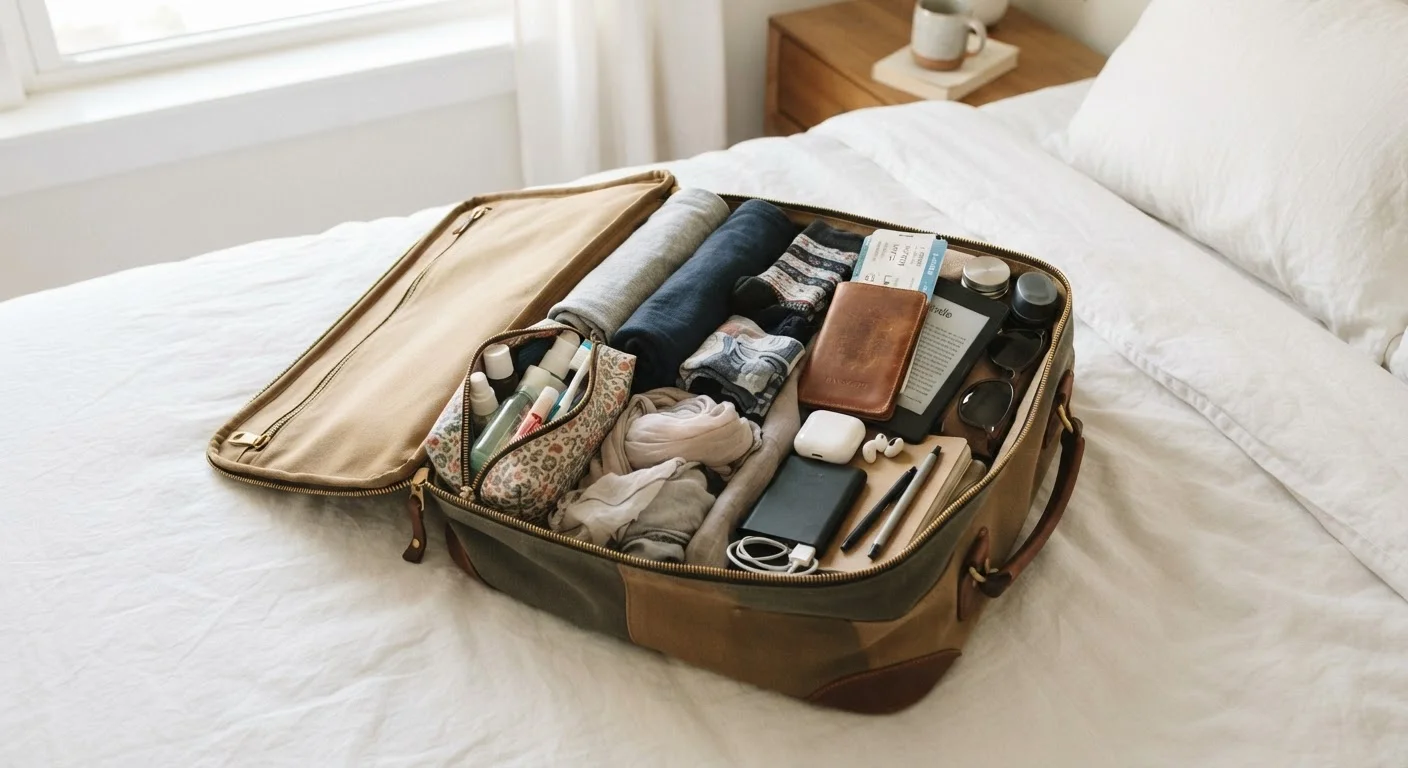
Photo: AnswersVista.com | Trustworthy Information Every Day editorial
Key Takeaways
- A personal item bag (typically 18"×14"×8" or smaller) can realistically hold seven days of clothing with the right fabric and outfit strategy.
- Choosing neutral, quick-dry fabrics and planning outfits around three to four base pieces dramatically reduces volume.
- Rolling clothes tightly and using packing cubes or compression bags maximizes every cubic inch of space.
- Toiletries, electronics, and shoes are the biggest space traps — each requires a deliberate downsizing decision.
- Wearing your bulkiest items on travel days reclaims meaningful bag space.
Why a Personal Item Bag Is a Realistic Goal
Most U.S. airlines define a personal item as a bag that fits under the seat — generally around 18"×14"×8", though this varies by carrier. That's roughly 15–18 liters of usable space. The instinct is to assume seven days requires far more room, but that assumption usually rests on habits — packing for every hypothetical, doubling up on items, and choosing bulky fabrics — rather than actual need.
Packing into a personal item isn't about sacrifice. It's about intentionality. Travelers who do it consistently report that the freedom of skipping bag check and moving through airports without waiting at carousels outweighs any minor inconvenience of a smaller wardrobe. For a broader look at whether this approach fits your specific trip, see our breakdown of carry-on versus checked bag trade-offs.
Before diving into steps, check your airline's specific personal item dimensions. Some budget carriers are stricter than others, and a bag that's borderline may get gate-checked — defeating the whole purpose.
What you will need
Step-by-Step: Packing Seven Days Into an Underseat Bag
The steps below walk through the entire process, from choosing your bag to doing a final fit test. Follow them in order — decisions made early (like clothing fabric) directly affect whether everything fits at the end.
Confirm your bag's dimensions against your airline's policy
Look up your specific carrier's personal item size limit before packing a single item. Budget airlines in particular vary widely. A bag that works on one airline may be flagged on another. If you're connecting on multiple carriers, use the most restrictive size limit as your standard.
Build a clothing list around a core color palette
Select three to four neutral base colors (such as navy, grey, olive, and white) so that every item mixes and matches. For a seven-day trip, a realistic clothing list looks like: 2 bottoms, 4 tops, 1 lightweight layer, 7 pairs of underwear, 3 pairs of socks, and 1 pair of shoes worn on the plane. Adjust for the specific nature of your trip — a beach week and a business trip have different demands, but the mix-and-match principle holds.
Downsize your toiletry kit ruthlessly
Lay out everything you think you need, then cut it by half. Solid toiletry formats (shampoo bars, solid sunscreen sticks, toothpaste tablets) eliminate most of your liquid burden. Decant remaining liquids into containers of 1 oz or less. If your accommodation provides basic toiletries, remove those items entirely from your kit.
Pack electronics flat and consolidated
Group all cables, chargers, and devices into one slim electronics pouch. A universal travel adapter, a short charging cable, earbuds, and your phone are sufficient for most trips. A laptop or tablet adds meaningful bulk — if you can use your phone for reading and navigation, leave the laptop behind or assess whether a personal item is the right bag for a working trip.
Roll clothing tightly and use structured packing cubes
Ranger-roll each garment: fold in the sleeves, roll tightly from the bottom up, then tuck the roll into the fabric collar to hold its shape. Place rolled items vertically in packing cubes so you can see everything at a glance without unpacking. Use one cube per category (tops, bottoms, underwear/socks) to stay organized throughout the trip.
Load the bag strategically
Place your heaviest items (shoes, toiletry bag, electronics pouch) closest to your back when the bag is worn. Stack clothing cubes in the main compartment. Use exterior pockets for items you need during the flight: documents, snacks, earbuds, a light jacket. Keep the bag's footprint as flat as possible to slide easily under the seat.
Do a dress rehearsal fit test at home
Pack the bag completely, then zip it and place it under a chair or table at approximately 10"–11" of clearance — a rough approximation of under-seat space. If it fits without forcing, you're ready. If not, identify what's adding bulk and eliminate or swap it before travel day. This step consistently reveals one or two items that can be cut without real impact on the trip.
Plan to Do Laundry Once
If this is your first time attempting a minimalist pack, our beginner's guide to packing smart covers foundational concepts around luggage types and organization systems that complement this walkthrough.
The Hardest Tradeoffs — and How to Handle Them
Shoes are the most space-consuming item most travelers pack. For a week-long trip in a personal item, one pair of versatile shoes worn on the plane plus one compact backup (such as packable flats or a pair of sandals) is the practical ceiling. If the trip requires dress shoes or heavy boots, a personal-item-only strategy may not be realistic — and that's a legitimate conclusion to reach. See our guide to choosing between carry-on and checked luggage for help making that call.
Toiletries shrink dramatically when you switch to solid formats (shampoo bars, solid moisturizer) or rely on hotel/rental amenities for shampoo and conditioner. Decant liquids into small reusable containers rather than packing full-size products. TSA's 3-1-1 rule applies regardless of bag type, so a quart-sized bag of liquids is already your limit on any flight.
Weather uncertainty is where most people over-pack. Rather than packing for worst-case scenarios with extra layers and rain gear, a thin packable jacket and moisture-wicking base layers handle most conditions. Our guide to building a versatile travel wardrobe goes deeper on layering strategies by climate type.
Don't Assume All Personal Items Are Equal
One final note on the return trip: buying anything on your travels — even small souvenirs — requires a plan. Either ship items home, buy compressible goods, or accept that you may need to wear everything on the flight back. Our piece on why bags always feel fuller on the way home addresses this challenge directly.
The content provided on our blog site traverses numerous categories, offering readers valuable and practical information. Readers can use the editorial team’s research and data to gain more insights into their topics of interest. However, they are requested not to treat the articles as conclusive. The website team cannot be held responsible for differences in data or inaccuracies found across other platforms. Please also note that the site might also miss out on various schemes and offers available that the readers may find more beneficial than the ones we cover.