
The Calorie: Useful Tool or Oversimplification?

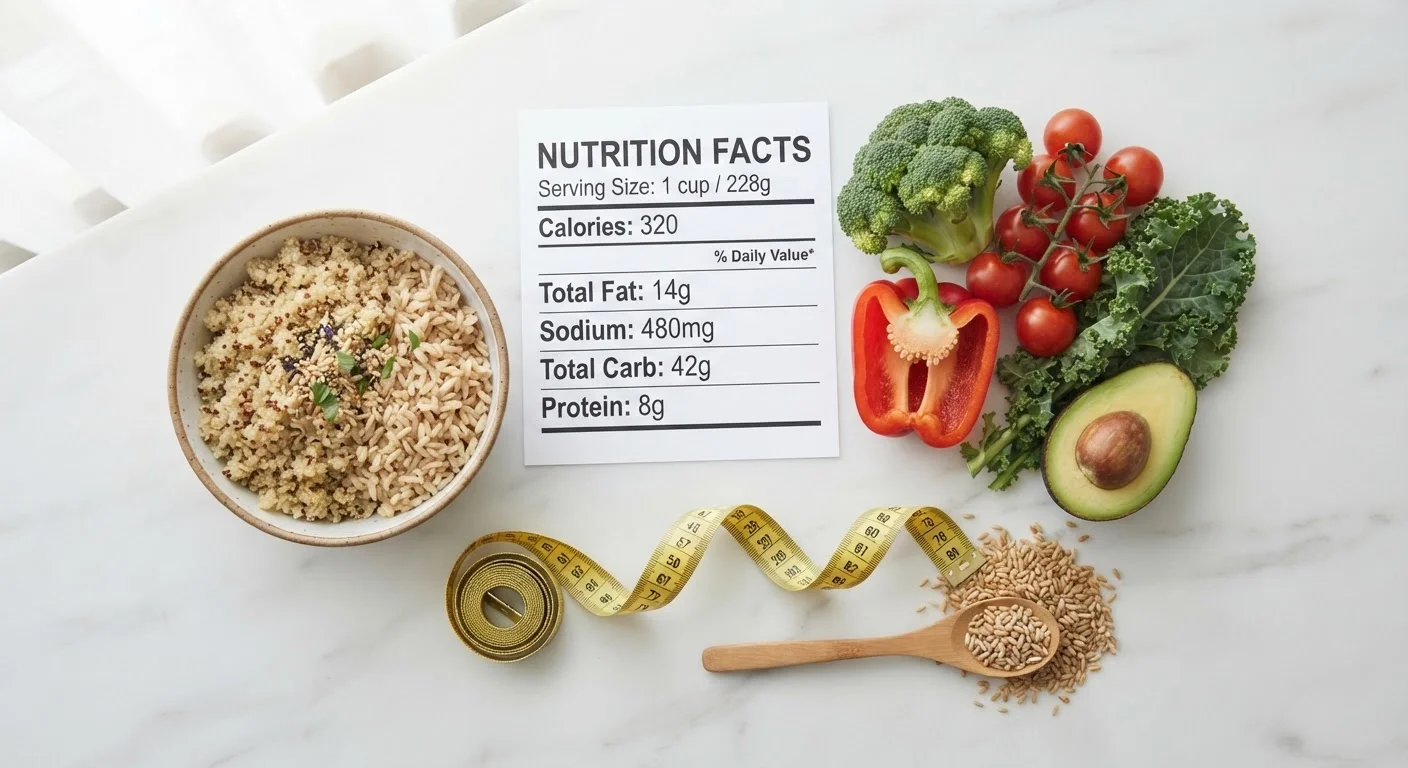
Photo: AnswersVista.com | Trustworthy Information Every Day editorial
Key Takeaways
- A calorie measures energy - specifically, the heat needed to raise one kilogram of water by one degree Celsius.
- Calorie counting can help raise awareness of portion sizes and overall energy intake.
- Two foods with identical calorie counts can have very different effects on hunger, metabolism, and health.
- Nutritional quality - fiber, vitamins, protein density - matters alongside, not instead of, calorie awareness.
- Rigid calorie counting is not appropriate for everyone and may be harmful for some individuals.
Creates awareness of portion sizes and energy intake
Many people significantly underestimate how much they eat. Tracking calories, even briefly, can reveal patterns that are otherwise invisible and help calibrate portion expectations.
Provides a common, measurable language for energy
Calories give dietitians, researchers, and the public a shared unit for discussing food energy - making dietary guidance more consistent and comparable across foods.
Supports understanding of energy balance concepts
Awareness of roughly how much energy different foods provide helps people understand the relationship between intake and expenditure in a concrete, actionable way.
Useful reference on standardized food packaging
Because calorie counts appear on all regulated Nutrition Facts labels in the US, they offer a quick, accessible comparison point when evaluating packaged food options.
Ignores nutrient density and food quality
Two foods with identical calorie counts can differ enormously in fiber, vitamins, protein, and health impact. Calories alone say nothing about what else a food delivers.
Does not account for individual metabolic variability
How many calories a person actually absorbs from a food depends on gut microbiome, food preparation, and personal physiology - factors a standard calorie count cannot reflect.
Misses satiety signals and hunger hormones
High-fiber, high-protein foods tend to produce greater and longer-lasting fullness than calorie-equivalent refined foods, a distinction calorie counts do not communicate.
Can foster a disordered relationship with food
For some individuals, rigid calorie tracking may contribute to anxiety, guilt, or obsessive eating behaviors. It is not an appropriate tool for everyone and should not be pursued without professional guidance if there is any history of disordered eating.
Food calorie values carry inherent measurement error
The standard Atwater system used to calculate food calories is an approximation; actual energy availability from foods like nuts or high-fiber vegetables can differ meaningfully from label figures.
What a Calorie Actually Measures
A calorie - technically a kilocalorie (kcal) on food labels - is a unit of energy. It represents the amount of heat energy required to raise the temperature of one kilogram of water by one degree Celsius. When applied to food, it describes how much chemical energy your body can extract from what you eat.
Every macronutrient provides a fixed caloric yield per gram: carbohydrates and protein each deliver roughly 4 kcal per gram, while fat provides about 9 kcal per gram. Alcohol contributes approximately 7 kcal per gram. These figures underpin the calorie counts printed on every Nutrition Facts label. For a plain-language guide to reading those labels, see how to read a Nutrition Facts label.
Understanding this basic definition matters because it clarifies both what calories can and cannot tell you. They measure energy - nothing more, nothing less.
Where Calorie Awareness Genuinely Helps
For many people, a rough sense of caloric intake is a practical anchor. Research consistently shows that portion distortion - underestimating how much we're eating - is common. Tracking calories, even loosely, can close that gap and inform more deliberate choices.
Creates awareness of portion sizes and energy intake
Many people significantly underestimate how much they eat. Tracking calories, even briefly, can reveal patterns that are otherwise invisible and help calibrate portion expectations.
Provides a common, measurable language for energy
Calories give dietitians, researchers, and the public a shared unit for discussing food energy - making dietary guidance more consistent and comparable across foods.
Supports understanding of energy balance concepts
Awareness of roughly how much energy different foods provide helps people understand the relationship between intake and expenditure in a concrete, actionable way.
Useful reference on standardized food packaging
Because calorie counts appear on all regulated Nutrition Facts labels in the US, they offer a quick, accessible comparison point when evaluating packaged food options.
Energy balance - the relationship between calories consumed and calories expended - remains a well-established concept in nutrition science. When someone consistently consumes significantly more energy than their body uses, excess is stored; a sustained deficit draws on stored energy. Calorie awareness supports understanding this dynamic. For a broader foundation in how energy fits within overall nutrition, Nutrition from Scratch is a helpful starting point.
~20%
Typical underestimation of daily calorie intake
Studies published in nutritional epidemiology journals consistently show people underreport their food intake by roughly 20% or more on average, even when trying to be accurate.
~30%
Thermic effect difference: protein vs. fat
Research indicates the body uses approximately 20-30% of protein calories in digestion and metabolism, compared to roughly 0-3% for fat - a difference calorie labels do not reflect.
Where the Calorie Model Falls Short
Treating calories as the only measure of diet quality creates a misleading picture. A can of soda and a serving of Greek yogurt may contain similar calorie counts, but they differ enormously in protein, sugar content, gut-health effects, and how long they keep you full.
Ignores nutrient density and food quality
Two foods with identical calorie counts can differ enormously in fiber, vitamins, protein, and health impact. Calories alone say nothing about what else a food delivers.
Does not account for individual metabolic variability
How many calories a person actually absorbs from a food depends on gut microbiome, food preparation, and personal physiology - factors a standard calorie count cannot reflect.
Misses satiety signals and hunger hormones
High-fiber, high-protein foods tend to produce greater and longer-lasting fullness than calorie-equivalent refined foods, a distinction calorie counts do not communicate.
Can foster a disordered relationship with food
For some individuals, rigid calorie tracking may contribute to anxiety, guilt, or obsessive eating behaviors. It is not an appropriate tool for everyone and should not be pursued without professional guidance if there is any history of disordered eating.
Food calorie values carry inherent measurement error
The standard Atwater system used to calculate food calories is an approximation; actual energy availability from foods like nuts or high-fiber vegetables can differ meaningfully from label figures.
Metabolic variability adds another layer of complexity. The number of calories your body actually absorbs and uses from a given food depends on factors including gut microbiome composition, food preparation method, and individual physiology - elements that standard calorie counts do not capture. Additionally, the thermic effect of food (the energy cost of digesting and metabolizing what you eat) differs by macronutrient: protein costs more to process than fat or carbohydrate.
For a deeper look at how ultra-processing affects nutritional value beyond calories, Whole Foods vs. Processed Foods covers the key distinctions.
A More Complete Framework for Everyday Eating
The most useful approach treats calories as one input among several, not as the final word on whether a food is healthful. Nutrient density - how many vitamins, minerals, fiber, and quality protein a food provides per calorie - is a concept that complements raw calorie counts meaningfully. Macronutrients, micronutrients, and what each does in your body explains this distinction in practical terms.
Calories and Special Populations
For those who find calorie counting helpful, even an approximate awareness - rather than precise logging - can provide benefit without the rigidity that may become counterproductive for some individuals. For practical guidance on building meals that naturally account for energy and quality together, what a balanced plate actually looks like offers an evidence-informed starting point.
This article is for general informational and educational purposes only and is not a substitute for personalized medical or dietary advice. Consult a registered dietitian or qualified healthcare professional before making significant changes to your diet, particularly if you have an existing health condition.
The content provided on our blog site traverses numerous categories, offering readers valuable and practical information. Readers can use the editorial team’s research and data to gain more insights into their topics of interest. However, they are requested not to treat the articles as conclusive. The website team cannot be held responsible for differences in data or inaccuracies found across other platforms. Please also note that the site might also miss out on various schemes and offers available that the readers may find more beneficial than the ones we cover.